Backgammon
First roll.
You play red. Each side rolls one die, and the higher number goes first.
Pips left 167
167 167
167
Nine rules and a pair of dice
Backgammon the way it is played across a table, one game at a time and without the doubling cube.
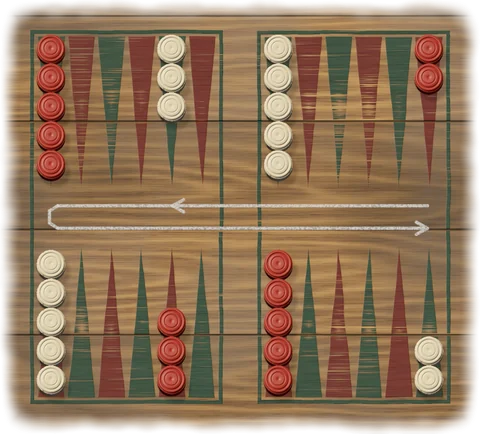
Fifteen pieces each, set up the same way every game. You play red and the computer plays white. The long triangles are called points, there are 24 of them, and each side starts on four.
Red travels from the top right to the bottom right. Your pieces go left along the top row, round the left side and back along the bottom row. The last six points, bottom right, are your home board. White goes the other way round and comes home in the top right.
One die each decides who starts. The higher number goes first and plays those two numbers. After that, every turn is a roll of both dice.
Each die is a move. With a 5 and a 3 you move one piece five points and another three, or one piece all eight. A double is played four times. If you can play both dice you have to, and if only one of them can be played it has to be the higher one when that is possible.
Two pieces hold a point. You can land on an empty point, on your own pieces, or on a single white piece. A point with two or more white pieces is closed to you, also as the stop in between when one piece plays both dice.
A single piece can be hit. Land on it and it goes to the bar, the strip of bare wood down the middle.
A piece on the bar comes in first. It enters in the other side's home board, on the point that matches a die, and nothing else of yours may move until it is in. If both points are closed, the turn passes.
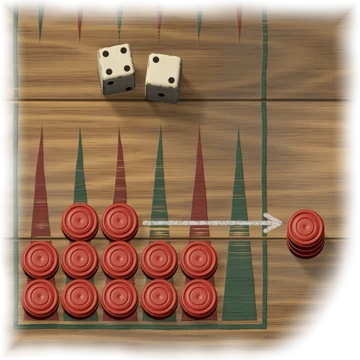
With all fifteen home, you take them off. A die takes a piece off the point with that number, counted from the right-hand edge. If the roll is higher than your furthest piece, the furthest one comes off instead.
First to take off all fifteen wins. It is a gammon if the loser has not taken off a single piece, and a backgammon if the loser also has a piece on the bar or in the winner's home board. Here every game counts as one win or one loss, and there is no doubling cube.
How games are won
Make points. Two pieces together cannot be hit, and white cannot land there. A 3 and a 1 on the first roll gives you the fifth point in your home board, and a 6 and a 1 gives you the seventh, the first point outside it.
Take your risks early. A piece hit in the first few turns has not come far and loses little. A piece hit late, when white's home board is full of closed points, can sit on the bar for the rest of the game.
Build a wall. Closed points next to each other block every roll that would land on them. Six in a row cannot be passed at all, and four or five in front of white's last two pieces will hold them for a long time.
Bring the two far pieces along. They start furthest from home, deep in white's home board. Move them up together while the way is open, or they end up behind a wall themselves.
Read the chalk numbers. The number on your side of the board is how many points your pieces have left to travel, all added up. When the two sides have passed each other and yours is the lower number, stop fighting and run for home.
No games played yet.
Red for the games you won, white for the ones you lost. Your record is kept in this browser and nowhere else.
Set up the board