Skip to the board
BARRELHEAD

Ludo

Your roll.

You play red, from the corner at the bottom left. The highest roll starts: tap the die.

How to play

Pieces homeYour pieces home:0White pieces home:0

Game
Opponent
Start over?

Four pieces, one die, once round the board

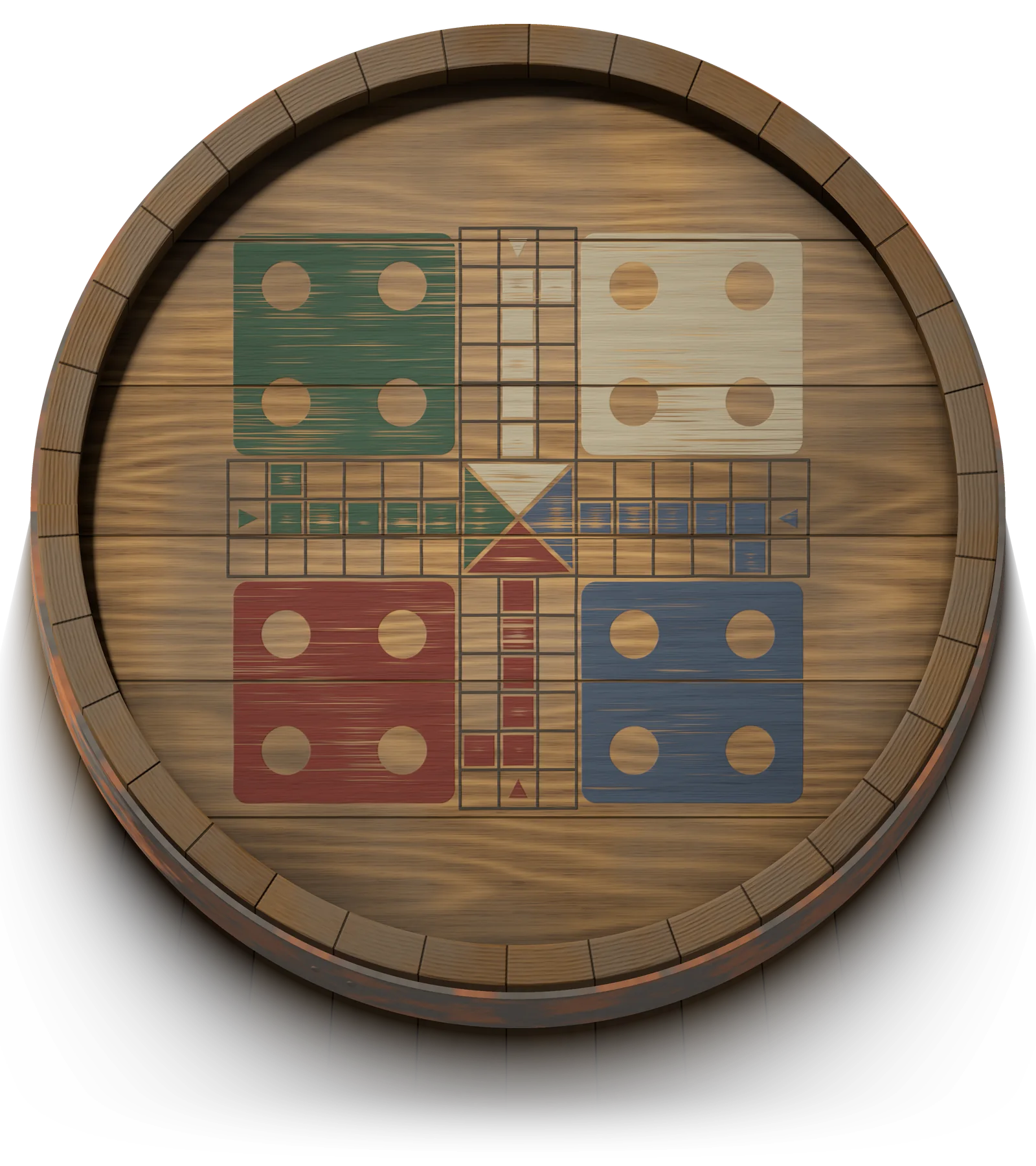
Ludo, the children's race game from late Victorian England, painted on the head of a barrel.

The board and the pieces

A cross with a yard in each corner. The squares along the outer edge of the cross are the track: 52 squares in a ring. The middle lane of each arm is painted in one color. That is a home column, five squares long, and it leads to the home in the middle.

Four pieces a side. You play red, from the yard at the bottom left. Against one opponent the computer plays white, from the corner opposite yours. With two opponents green joins at the top left, and with three blue joins at the bottom right.

Every color has its own mark. Red pieces carry a dot, green a stripe, white a ring and blue a cross, so the four sides can be told apart by shape as well as by color.

One die. It lies in the yard of the side whose turn it is. All sixteen pieces start in their yards, on the round places of bare wood.

Who starts

Every side rolls the die once, and the highest roll starts. Sides that share the highest roll roll again. After that the turn goes clockwise: red, green, white, blue, leaving out the colors that are not in the game.

A turn

Roll the die, then move one piece. Tap the die. Then tap one of your pieces, and it moves exactly as many squares as the die shows. You choose the piece, never the distance. With Show moves on, the pieces that can use the roll have a chalk ring.

If a piece can move, one has to. If none can, the turn passes, and the line under the board says why.

Only a six brings a piece out of the yard. The piece is put on your start square, the painted square of your color beside your yard. That is the whole move.

A six gives another roll. You roll again after the move, and also when the six could not be played at all. There is no limit here: a third six in a row is played like any other.

Pieces go clockwise. From its start square a piece goes all the way round the track, turns in at the painted arrow in front of its own home column, and goes up the column to the middle.

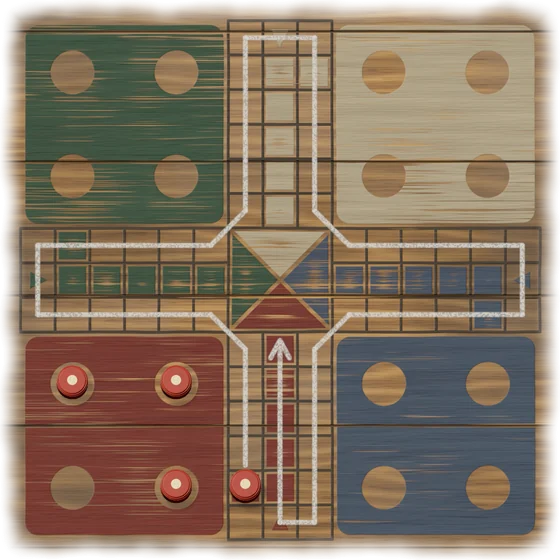
The whole ludo board. A red piece stands on the red start square next to the red yard, and a chalk line runs from it clockwise round the whole track, back to the bottom arm, up the red home column and ends in an arrow at the red triangle in the middle.
The way of a red piece: out on the red square, once round the track, in at the red arrow and up the red column to the middle. The other colors do the same from their own corners.

Capturing

Land on a single piece of another color and it goes back to its yard. It has to wait for a six to come out again. Only the last square of a move counts: a piece that passes over another piece does nothing to it.

No square on the track is safe. Not even a start square: a piece that comes out of its yard captures a single piece of another color standing there.

Capturing is a choice. If another piece can use the roll, you may move that one. A capture earns no extra roll and no extra steps.

Blocks

Two pieces of the same color on one square are a block. On this board they stand on top of each other. Three or four on one square are a block as well.

No other color can land on a block or pass it. A piece behind a block can move up to the square before it and no further. A block on a start square keeps that color from bringing a piece out.

Your own block does not stop you. Your pieces pass it and may stop on it. It lasts until you move one of its pieces, and nothing forces you to as long as another piece can use the roll.

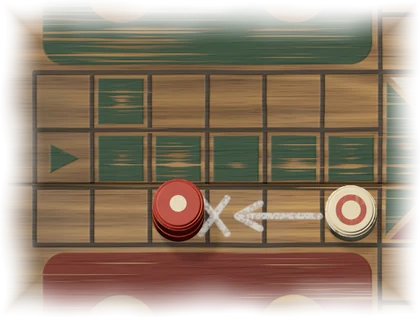
A stretch of the track with two red pieces stacked on one square. Three squares behind them stands a white piece. A chalk arrow from the white piece toward the red pieces ends in a chalk cross just before them.
Two red pieces on one square. The white piece behind them can go one or two squares, but a three, a four, a five or a six cannot be played with it.

The home column and home

A piece leaves the track after 50 steps. The square with the arrow in your color is the last one on the track. From there the piece turns onto your home column, where no other color ever comes and nothing can be captured.

Home takes the exact roll. A piece three squares from the middle gets home with a three. With a one or a two it moves closer, and with anything higher it cannot move at all.

From start square to home is 56 steps: 50 along the track, five on the column and one into the middle.

How a game ends

The first side with all four pieces home wins. The game stops there, also with three or four sides at the board: the others do not play on for second place. There are no draws.

Rules you may know that are not played here

  • Three sixes in a row: in other rules the third six is lost. Here it is played.
  • A one also brings a piece out: here only a six does.
  • Safe squares: here there are none on the track.
  • An extra roll for capturing or for getting home: here only a six gives one.
  • Landing on a block sends your own piece home: here you cannot land on a block at all.

The engine behind this board can play several of these, but its levels have only been measured with the rules above, so those are the only ones offered.

Sources

The rules on this board are the ones Masters Traditional Games gives in its Rules of Ludo: a six to leave the yard, a six for another roll, blocks that cannot be passed, and the exact roll to get home. A piece coming out is put on its start square, as Wikipedia's article on ludo describes it, and the other rules listed above are from the same article. Everything is checked against the engine that runs this board.

Questions people ask

Do I need a six to start?

Yes. A piece leaves the yard only on a six, and until one comes there is nothing to do but roll. On average the first six takes six rolls. One player in three is still waiting after six rolls, and one in six after ten.

What does a six do, and what about three in a row?

It brings a piece out of the yard, and it gives you another roll. You do not have to use it to bring a piece out: any piece that can go six squares may take it instead.

Three sixes in a row are all played, and you roll a fourth time. The rule that the third six is lost is not followed on this board. It would come up once in 216 turns.

Do I have to move?

Yes, if any piece can. That holds even when the only possible move breaks up a block or puts a piece right in front of an opponent.

When exactly one piece can move, the board still waits for your tap. With Speed set to Fast under Settings it moves that piece for you after a short pause.

Which piece do I tap when two stand close together?

On a phone the first tap moves them apart. When two or more of your pieces that can move stand closer together than a fingertip, a tap on them slides them apart, and a second tap picks the one you mean. A tap anywhere else puts them back.

Two of your pieces on the same square are a different matter: it makes no difference which of them moves, so the board takes the top one.

How long does a game take?

Longer than most games here. In 2,000 games that the engine's middle level played against itself, a game for two took about 190 rolls in all, a little under a hundred for each side. With three at the board it took about 380 rolls, and with four about 660.

Is the die fair?

Every roll comes from the same die, for you and for the computer. When a game starts it draws a seed at random. Each roll is worked out from that seed and from its number in the game, and from nothing else: not the position, not whose turn it is.

The computer is handed the roll that lies on the board and is never told what comes next. Undo gives you the same roll again, so a roll cannot be changed by taking it back.

Can two, three or four people play on one device?

Yes. Choose No computer under Opponent, and every color in the game is moved by tapping, in turn, by whoever sits at the screen. The choice under Game sets how many colors are in.

A game with both people and computer players at the same board is not offered. Games without the computer are not counted in your record.

Where does the game come from?

From pachisi, a much older Indian game played on a cross of cloth. Ludo is a simplified version with a single die, sold in England under that name from 1896. The word is Latin for "I play". Parcheesi, the American game from the same root, is played with two dice and has rules of its own.

Mensch ärgere Dich nicht in Germany, Parchís in Spain and Fia in Sweden belong to the same family.

How games are won

First, what skill can do

The die decides most single games of ludo. The player who rolls sixes early and exact numbers late will usually win, whatever the other side does.

What is left to you is one choice a turn: which piece moves. Over many games that choice adds up. The engine's best level wins about six games in seven against its weakest, and the whole difference between them is which piece they pick.

Get a second piece out

When a six comes and you have pieces in the yard, bringing one out is usually right. A piece in the yard is doing nothing, and the next six may be a long way off.

A side with one piece on the board also has no choices: every roll goes to that piece. The exceptions are a six that captures, and one that carries a threatened piece out of reach.

Count the squares behind you

Pieces only move forward, so the danger to a piece is whatever stands behind it. Count the squares back to the nearest piece of another color.

  • One to six squares: one roll in six lands on you, about 17 percent. From one to five squares it is a little more, 19 percent, if that side has another use for a six, because a six followed by the right number does it too.
  • Seven to twelve squares: it takes a six and then the exact number. One chance in 36, about 3 percent.
  • More than twelve: two sixes and more. Under 1 percent.

So the seventh square is the one that matters: a piece seven squares clear is six times safer than a piece six squares clear. Two pieces behind you at different distances mean two rolls that hit, and with several opponents each of them gets a roll before your next turn.

The same count works the other way. A piece cannot be captured by the piece in front of it, so the square just behind an opponent is a good one: you threaten it and it does not threaten you.

When to capture

A capture costs the other side every step that piece had taken, and the wait for a new six on top. The further the piece had come, the more the capture is worth.

Look at where your own piece ends up, though. If the capture leaves it within six squares in front of another piece, you may be paying for it on the next roll.

When to run and when to block

Run with the piece that has the most to lose. A piece near the end of its lap has many steps behind it and is safe as soon as it reaches the home column. When an opponent is within reach of it, get it there.

Block where it holds something up. Two pieces together cannot be captured, and nothing of another color gets past them. A block a few squares in front of an opponent's pieces costs that side roll after roll.

A block has a price. Moving it on breaks it, and while it stands your other pieces have to carry every roll. Keep it while it is in somebody's way.

Do not let the last squares waste your rolls

A piece two squares from home can use a one or a two. The other four numbers are lost if it is your only piece that can move, and a piece one square from home waits six rolls on average.

A piece still out on the track takes the rolls that are too high. So bring the pieces round together where you can, and late in the game use small rolls on the home column and large ones on the track.

With three or four at the board

Every piece has more enemies behind it, and whoever is ahead draws the fire. Blocks and the home column are worth more, and a capture is worth less than it looks: it sets one opponent back and leaves the others where they were.

How the computer plays here

Five levels, one engine. The steps between the levels are small, because the die decides most games. The numbers below say how small.

How it thinks

The computer is given the position and the roll that lies on the board, and it picks a piece. It never rolls for itself, and it knows nothing about the rolls to come: to the engine every number is equally likely.

The three lower levels pick by habit. The two upper levels score the position each move would lead to: the steps the pieces have taken, less what the side can expect to lose.

  • Danger: for each piece on the track, the chance that an opponent lands on it before the side's next turn, times what the piece would lose.
  • Blocks: two pieces together cannot be captured, and standing just behind another color's block costs rolls.
  • Lost rolls: numbers that none of the side's pieces could use, and the wait for a six that every piece in the yard stands for.

All of this happens on your own device. Several computer opponents all play at the level you have chosen, each for itself.

Beginner

Moves the first of its pieces that can move. That makes it run with one piece at a time, bring out a new one only when nothing else can use the six, and capture only when it happens to.

Easy

Knows the habits: capture when you can, otherwise bring a piece out, otherwise move the piece that has come furthest. In about half of its moves it forgets them and moves the first piece that can.

Medium

Follows the habits in every move. It does not see danger: it leaves a threatened piece where it is, and it will stop right in front of one of yours.

Hard

Scores the position after its own move, with danger, blocks and lost rolls counted in. It does not look at the rolls that follow. In about one move out of twenty it plays by habit instead.

Expert

Uses the same score and looks three rolls ahead: its own move, each of the six numbers the next side can roll with that side's best move on every one, and the roll after that. It is never careless.

The levels against each other

Each level has played the level below it with mirrored dice: every series of rolls is played once from each seat, so that a lucky seat helps both levels equally. The figures were measured on 9 October 2026, with the rules on this page.

With two at the board, games won out of games played:

  • Easy against Beginner: 2,702 of 4,000, or 67.5 percent.
  • Medium against Easy: 2,588 of 4,000, or 64.7 percent.
  • Hard against Medium: 2,242 of 4,000, or 56.0 percent.
  • Expert against Hard: 2,364 of 4,000, or 59.1 percent.
  • Expert against Beginner: 1,710 of 2,000, or 85.5 percent.

With four at the board, one player of a level against three of the level below. Four equal players would win 25 percent each.

  • Easy against three Beginners: 1,498 of 4,000, or 37.5 percent.
  • Medium against three Easy: 1,643 of 4,000, or 41.1 percent.
  • Hard against three Medium: 1,130 of 4,000, or 28.2 percent.
  • Expert against three Hard: 1,158 of 4,000, or 28.9 percent.
  • Expert against three Beginners: 1,094 of 2,000, or 54.7 percent.

With 4,000 games behind a figure, its measuring error is a little under one percentage point.

What the numbers mean

Luck decides most single games. A level that wins 56 games in a hundred against the one below it also loses 44. Even Beginner, which hardly chooses at all, takes one game in seven from Expert.

The steps are real but small. In four in a row on this site, a level takes close to nine games in ten from the level below it. Here good choices are worth one or two more wins in ten, and less with four at the board: Expert alone against three Hard players wins 29 games in a hundred, where 25 would be no advantage at all.

So a single game tells you little. Beating Expert once does not mean you play better than it does. The level suggestion after three wins or losses in a row should be read the same way.

What has not been measured. Games with three at the board have not been measured at all. No person has played these levels in a counted series of games, so how they compare with people is not known.

What the hint is

The Hint button uses Expert's score and looks one roll further, four in all, within one second. Against Expert itself that extra roll won 524 games of 1,000 with two at the board, which is within the margin of error: the hint is at least as good as Expert, and not provably better.

Hints are counted, and the count is shown with your record at the bottom of the page.

Sources

The figures are the engine's own, from matches between its levels. The chances in the part about strategy are counted from one fair die: one face in six, and one in 36 for a six followed by a given number.

The other barrels

Checkers is the one where a jump has to be taken, and where a piece that reaches the far row becomes a king, two pieces high.

Backgammon is a race with dice: fifteen pieces a side, and a piece left on its own can be hit and sent back to the start.

Shut the Box is nine numbered tiles and two dice: every roll has to be paid for with tiles that add up to it, and the lower sum left open wins.

Farkle is six dice and a race to 10,000: bank what a turn is worth, or roll again and risk losing all of it.

Yatzy is five dice and a scorecard of thirteen rows: three rolls a turn, and every turn has to be written in a row, even when it is worth nothing there.

Dominoes is twenty-eight tiles and a line that grows at both ends: match a number, draw from the boneyard when nothing fits, and lay your last tile first.

Reversi has one kind of move: put a piece down so that it traps a row of the other color, and the row turns to yours.

Mancala has no dice and nothing hidden: you empty a pit, sow its stones round the board one at a time, and count what ends up in your store.

Chinese Checkers is a race across a star of 121 holes: marbles hop over one another in chains, nothing is ever captured, and the first side to fill the point opposite wins.

Nine Men's Morris is the old game of mills: nine pieces a side, three in a row along a line takes a piece off, and a side left with two pieces or no move has lost.

Tic-Tac-Toe is three in a row on nine squares, and next to it Ultimate tic-tac-toe, where every square holds a small board and each move decides where the next one is played.

Four in a Row is the standing rack laid flat: seven lanes of six places, a piece slides down its lane until it is stopped, and the first side with four in a row wins.

Chess is the old game of kings: six kinds of pieces that each move their own way, and a win when the other king is attacked and cannot escape.

Gomoku is five in a row on a board of fifteen lines each way: pieces go where the lines cross, and three in a row with both ends open has to be answered at once.

Against one

No games played yet.

Red for the games you won, white for the ones you lost. Games against one, two and three opponents are counted apart, and this is the record of the game on the board. It is kept in this browser and nowhere else.

Start over?