Skip to the board
BARRELHEAD

Shut the Box

Your roll.

You play first. Roll the dice, then shut tiles that add up to the roll. Whoever leaves the lower sum open wins.

Left openYou:45The computer:45

Opponent
Start over?

Nine tiles and a pair of dice

Shut the box the way it is played in pubs: tiles 1 to 9, two dice, and the lower sum left open wins.

The box and the tiles

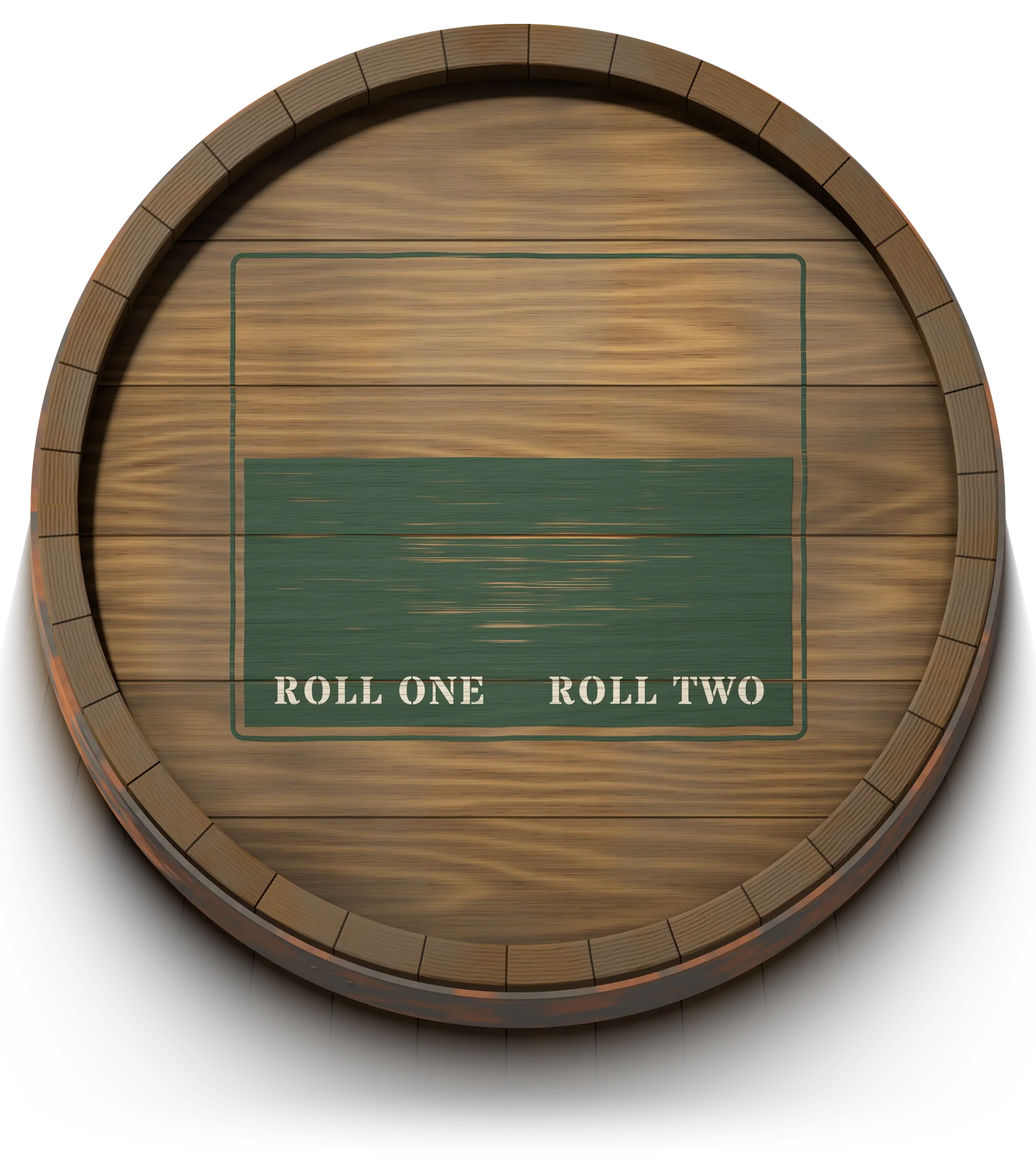
Nine tiles numbered 1 to 9, all of them open at the start. The real thing is a wooden tray with the tiles on a rod along one side. Here the box is painted on the barrel head: the tiles lie in a row with their numbers up, and the green field below them is where the dice land.

Each side gets the tiles to itself for one round. You play your whole round first, unless you give the first round to the computer under Settings. Then the tiles are set up again and the other side plays its round on the same lid.

Rolling and shutting

Roll both dice and add them up. Then shut open tiles that add up to exactly that number. A roll of 9 can be paid for with the 9, with the 4 and the 5, with the 1, the 2 and the 6, or with any other open tiles that make 9.

The two dice count as one number. With a 6 and a 3 you may shut the 6 and the 3, but only because they add up to 9. You cannot shut one set of tiles for the 6 and another for the 3.

A shut tile stays shut for the rest of your round. It is turned face down and lies one row nearer to you, so the numbers you can still see are the ones that count against you.

Then you roll again, and go on rolling and shutting until a roll comes that you cannot pay for.

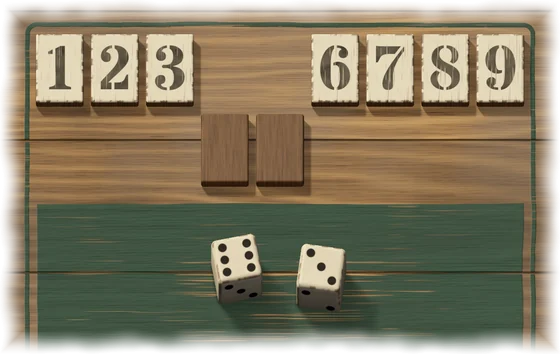
The row of nine tiles with the 4 and the 5 turned face down and lying a row lower than the others. On the green field below, two dice show 6 and 3.
A 6 and a 3 make 9. Here it was paid for with the 4 and the 5. The 9 alone would also do, and so would the 1, the 2 and the 6.

One die or two

Once the 7, the 8 and the 9 are all shut, you may roll one die instead of two. From then on the choice is yours before every roll. One die gives 1 to 6, two dice give 2 to 12.

Until then it is always two dice. The words painted on the field show what is allowed: the one with a chalk frame around it can be pressed.

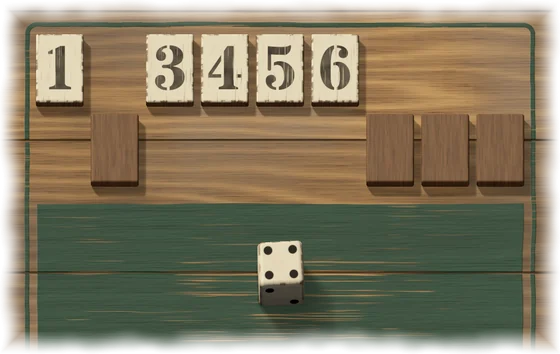
The row of tiles with the 2, the 7, the 8 and the 9 turned face down. A single die on the green field shows 4.
The 7, the 8 and the 9 are shut, so one die is allowed. Its 4 can be paid for with the 4, or with the 1 and the 3.

How a round ends

A round ends with the first roll you cannot pay for. If no set of open tiles adds up to the roll, the tiles stay as they are and the round is over.

Your score is the sum of the tiles still open. Leave the 1, the 2 and the 6 and you have 9. The chalk number beside the box keeps count while you play: yours is below the box, the computer's above it.

Winning

The lower score wins. Equal scores are a draw.

Shutting all nine wins on the spot. That is shutting the box. If the side that plays first does it, the other side does not get a round at all.

House rules you may know

The game has no rulebook and no governing body, so nearly every box comes with its own rules. These are the ones that differ most often from what is played here.

Always two dice. Some play without the one-die rule. Others allow or demand a single die when the open tiles add up to 6 or less, instead of when the 7, the 8 and the 9 are shut.

Only the dice or their sum. A simpler game for younger players lets you shut the tile of the total, the tile of one die, or the tiles of both dice. A version from Thailand always uses two dice and lets you shut a single tile per roll: one of the two dice, or their sum.

More tiles. Boxes with ten or twelve tiles are sold too. Twelve tiles and two dice make a much harder game.

Other ways to count. Counting the sum of the open tiles, as here, is sometimes called golf. Some count how many tiles are left open instead. Others read the open tiles as one number, so that the 1, the 2 and the 5 left open is 125.

Several rounds. In English pubs it has traditionally been played for a pool of money, and in longer games the scores are added up from round to round, with a player dropping out on reaching 45.

Sources

Checked against the rules in Wikipedia's article on shut the box, which also lists the variants, and against the engine that runs this board. Played here: nine tiles, any open tiles that add up to the roll, one die allowed once the 7, the 8 and the 9 are shut, and a shut box wins at once.

Questions people ask

Can you shut the two tiles the dice show?

Yes, because they add up to the roll. With a 2 and a 5 you can shut the 2 and the 5. You can just as well shut the 7, the 1 and the 6, the 3 and the 4, or the 1, the 2 and the 4. What the single dice show does not matter, only their sum.

How many tiles can you shut on one roll?

As many as it takes to make the sum. A 10 can be paid for with four tiles: the 1, the 2, the 3 and the 4. No sum that two dice can make needs more than four.

Can you use the same tile twice?

No. Each number exists once. A double 4 is an 8, and it has to be paid for with tiles that are still open and add up to 8. The 4 can be one of them only once.

When can you roll just one die?

When the 7, the 8 and the 9 are all shut. Then the words Roll one on the green field get a chalk frame, and you may pick either before each roll. You never have to roll one die here.

Should you roll one die as soon as you can?

No. One die can never make more than 6. If your open tiles add up to more than that, a single die cannot shut them all in one go, and two dice often shut more. For shutting the box, the exact rule is short: roll one die when the open tiles add up to 6 or less, and two dice otherwise.

The clearest case is a lone 1. Two dice cannot roll a 1, so only a single die can shut it, and it does so one time in six.

What are the odds of shutting the box?

A little under one round in ten, at best. Played perfectly with nothing in mind but shutting the box, a round ends with all nine tiles down 9.76 percent of the time. Without the one-die rule it is 7.14 percent. With twelve tiles and two dice it falls to 0.36 percent, about one round in 280.

Playing for the lowest score instead, perfect play leaves 11 points open on average.

Is it an advantage to play first?

Barely. The side that plays second knows the score to beat and can aim for it. The side that plays first wins at once if it shuts the box. With perfect play on both sides the two nearly cancel out: the first side wins 50.15 percent of the games, counting a draw as half a win.

Can a game end in a draw?

Yes. If both sides leave the same sum open, nobody wins. A draw is counted as a draw in your record.

Can you take a roll back?

No. A roll stands. Undo here takes back your choice of tiles and gives you the same roll to pay for another way, and it works until you roll again. Tiles you have picked but not yet shut go back with another press on them.

Is shut the box luck or skill?

Mostly luck. You choose which tiles to shut, and later whether to roll one die or two. Everything else is the dice. The levels on this page show how much the choosing is worth: the best level here beats the weakest in 87 games of 100, and beats the next best in 55.

Where does the game come from?

Nobody knows for certain. It is a pub game. A British trade paper of 1967 called it a game from the Channel Islands that had reached the pubs of Manchester, and older origins are claimed without much proof. In the United States the television quiz High Rollers was built on it in the 1970s.

Does the computer get better dice?

No. Every roll comes from the same source, whoever's round it is, and the computer is never shown a roll before it is on the lid. How the dice are made is further down this page.

How games are won

Shut the high tiles first

Low tiles are useful for a long time, because small numbers fit into many sums. The 9 fits into few, and only a roll of 9 or more can shut it. So when a roll can be paid for with one high tile or several low ones, take the high tile. A 9 is better spent on the 9 than on the 4 and the 5.

Use as few tiles as you can

Every tile you shut is one fewer way to pay for a later roll. Shutting the 1, the 2 and the 3 for a 6 leaves you with no small change at all. The weakest level here plays exactly like that, and it is why it loses.

Keep the 7 in mind

Seven is the most common roll of two dice: 6 of the 36 ways the dice can fall. Sixes and eights come 5 times each, and a 2 or a 12 only once. A set of open tiles that can pay for a 6, a 7 and an 8 will survive nearly half of all rolls on those three numbers alone.

Know when one die is right

With the 7, the 8 and the 9 shut, count what is still open. If it adds up to 6 or less, one die gives you the best chance of shutting the box. If it adds up to more, two dice usually keep the round alive longer.

When you play second, it also depends on the score you have to beat. If you are already under it, nothing more can go wrong, and the only reason to roll on is the pleasure of it.

Play the score when you go second

The computer's score is chalked above the box when your round begins. Needing to get under 5 calls for other choices than needing to get under 20. Close to a low target, keep the tiles that the next roll is most likely to need. Far ahead of it, anything works.

Ask for a second opinion

The Hint button shows what the computer would do at full strength: which tiles to shut for the roll on the lid, or whether to roll one die or two. It counts the whole game, your opponent's score included, and not just the next roll.

How the computer plays here

Five levels. The best one works out the exact answer, and the other four each follow a rule of thumb with a known fault.

How it thinks

Shut the box is small enough to be solved outright. Nine tiles can be open or shut in 512 ways, and from each of them every roll and every legal answer can be followed to the end of the round. The engine does that, and so it knows the exact chance of winning after every possible choice.

Playing first, it counts what the other side is likely to do with its round. Playing second, it knows the score it has to beat and plays for that and nothing else.

The numbers match those published for the game: 9.76 percent for shutting the box with the best play, and 7.14 percent when two dice are always rolled. All of it happens on your own device, in your browser.

Beginner

Shuts as many tiles as it can for every roll, the lowest ones first. It runs out of small tiles early, and after that almost no roll can be paid for. It always rolls two dice.

Easy

Shuts the two tiles that the dice show. When it cannot, it uses as few tiles as possible, with the highest one that fits. The high tiles are left open far too long. It always rolls two dice.

Medium

Takes the 7, the 8 or the 9 whenever the roll is one of those numbers and the tile is open. Otherwise it plays like Easy.

Hard

Follows the old rule: as few tiles as possible, the highest first. Its one fault is the single die, which it rolls the moment it is allowed instead of when it pays.

Expert

Works out the exact chance of winning for every choice and takes the best one. It cannot be outplayed, only outrolled.

The levels against each other

These are not measured by playing games. The game is small enough for the result between two levels to be worked out exactly, over every way the dice can fall. Each figure is the average of playing first and playing second, with a draw counted as half a win.

  • Easy against Beginner: 68.1 percent.
  • Medium against Easy: 59.0 percent.
  • Hard against Medium: 59.8 percent.
  • Expert against Hard: 55.3 percent.
  • Expert against Beginner: 86.7 percent.

This is a game of luck. Perfect play wins only 55 games in 100 against the old rule of thumb, and it still loses about 13 in 100 to a level that throws its small tiles away. Worked out on 9 October 2026.

What the hint is

The Hint button asks the engine at Expert's strength. In this game that is the best move there is, not just the computer's best guess.

How the dice are rolled

When a game starts, the page draws one random number. Every roll in that game is worked out from that number and the number of the roll: the first roll of the game, the second, and so on, whoever makes it. The code that makes the roll does not know which side it is for.

The computer is handed the tiles and the roll that is on the lid, and nothing else. It never sees a roll that has not been thrown yet, its own included. A roll is never taken back either, so there is no way to fish for a better one.

On 9 October 2026 the generator was run for 2 million rolls of six dice, 12 million dice in all. Each of the six faces came up between 16.65 and 16.68 percent of the time, where a perfect die gives 16.67. The average die showed 3.500 on odd-numbered rolls and 3.499 on even-numbered ones, against the 3.5 that fair dice give.

Why fair dice still feel unfair

A round is short: a handful of rolls, and never fewer than four to shut the box. One awkward roll at the wrong moment decides it, and over time it comes for both sides equally often.

With the 1 and the 2 left open, 33 of the 36 rolls of two dice end your round. Only a 2 or a 3 keeps it going. Whether that happens to you or to the computer in a given game is luck. Over many games it evens out, and what is left is the few percent the choices are worth.

The other barrels

Checkers is the one where a jump has to be taken, and where a piece that reaches the far row becomes a king, two pieces high.

Backgammon is a race with dice: fifteen pieces a side, and a piece left on its own can be hit and sent back to the start.

Farkle is six dice and a race to 10,000: bank what a turn is worth, or roll again and risk losing all of it.

Yatzy is five dice and a scorecard of thirteen rows: three rolls a turn, and every turn has to be written in a row, even when it is worth nothing there.

Reversi has one kind of move: put a piece down so that it traps a row of the other color, and the row turns to yours.

Mancala has no dice and nothing hidden: you empty a pit, sow its stones round the board one at a time, and count what ends up in your store.

Chinese Checkers is a race across a star of 121 holes: marbles hop over one another in chains, nothing is ever captured, and the first side to fill the point opposite wins.

Nine Men's Morris is the old game of mills: nine pieces a side, three in a row along a line takes a piece off, and a side left with two pieces or no move has lost.

Tic-Tac-Toe is three in a row on nine squares, and next to it Ultimate tic-tac-toe, where every square holds a small board and each move decides where the next one is played.

No games played yet.

Red for the games you won, white for the ones you lost. Your record is kept in this browser and nowhere else.

Start over?