Skip to the board
BARRELHEAD

Reversi

Your move.

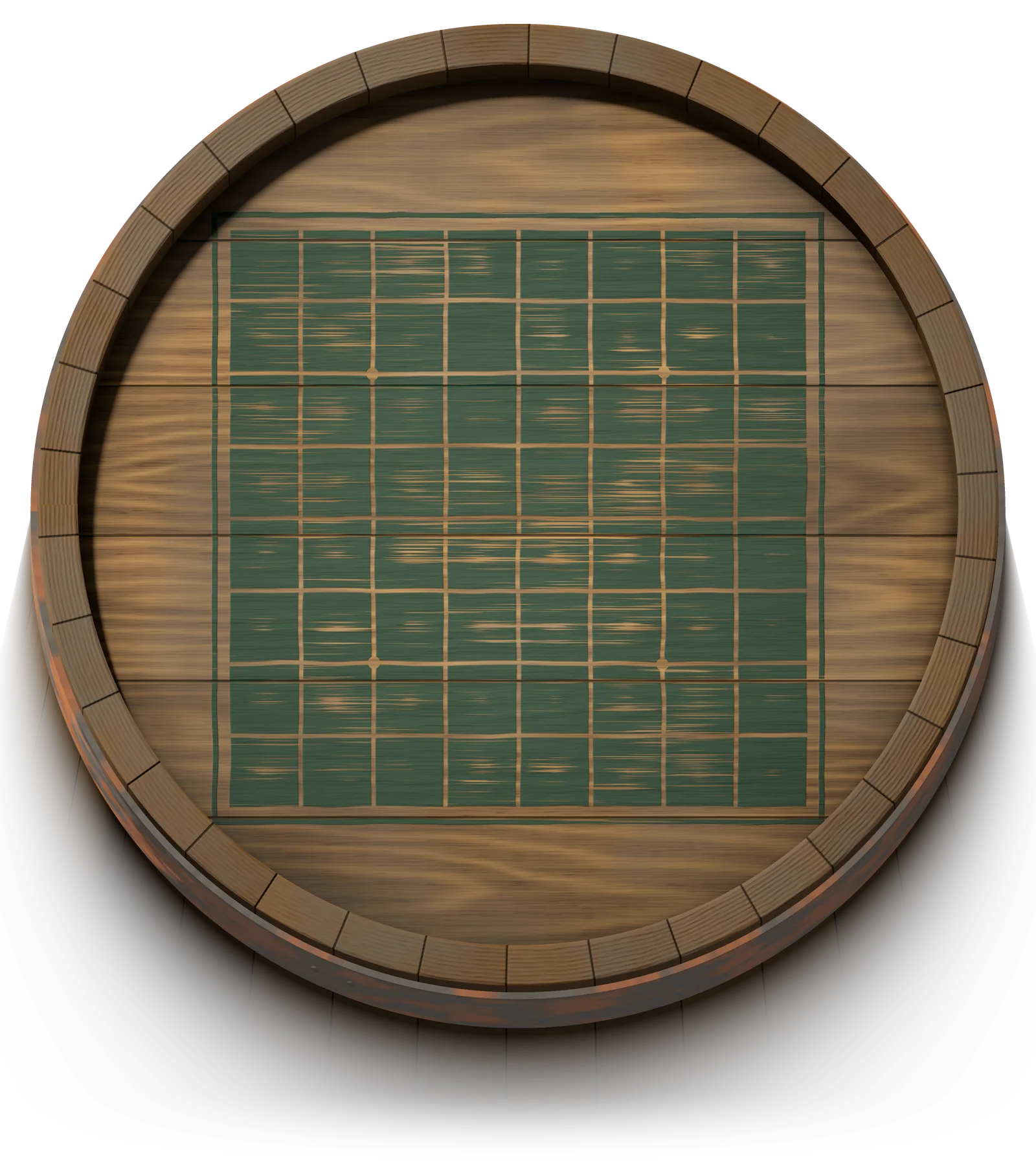
You play red and go first. Tap a dot to put a piece there. White pieces between two of yours turn red.

How to play

Pieces on the boardYour pieces:2The computer's pieces:2

Opponent
Start over?

Six rules and you know the game

Reversi, the game many people know as Othello.

The board and the start

Sixty-four squares, all of them in play. You play red and the computer plays white, unless you swap the colors under Settings.

Four pieces start in the middle, two of each color, set corner to corner. That fixed start is the modern form of the game and the one tournaments use. In the reversi of the 1880s the board began empty, and the players put the first four pieces in the middle themselves.

Red goes first. After that the two sides take turns, one piece each. Under Settings your color and the first move are separate choices, so on this board white can be the side that starts.

Trapping and turning

Every move has to trap something. You put a piece on an empty square so that one or more white pieces sit in a straight, unbroken line between it and another red piece. The line can run along a row, up and down, or on a diagonal.

Trapped pieces turn over. Every white piece in that line becomes red. One move can trap lines in several directions at once, and then all of them turn.

A line ends at the first red piece. White pieces beyond it are not part of this move, and an empty square anywhere in the line breaks it.

Only the piece you put down traps. If the turning leaves other white pieces sitting between two red ones, they stay white. Nothing turns because something else turned.

Everything trapped turns. You cannot choose to leave part of a line alone.

A piece never moves. Once it is down it stays on its square for the rest of the game, whatever color it shows.

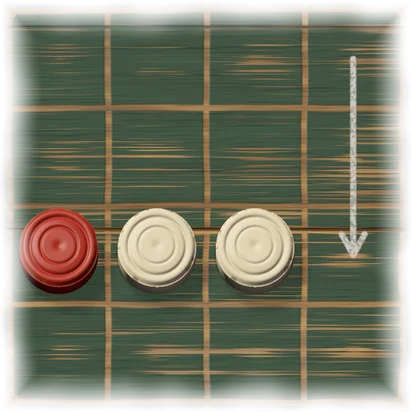
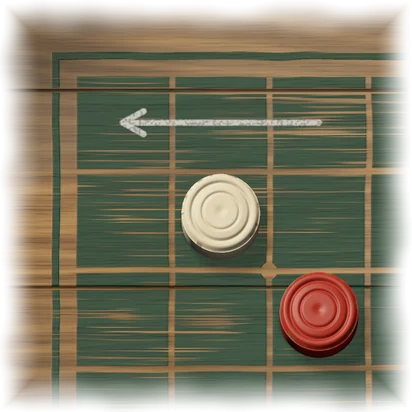
A red piece and two white pieces in a row, with a chalk arrow pointing at the empty square after them.
Red plays where the arrow points. The two white pieces are trapped and turn red.

When you cannot move

No trap, no move. If there is nowhere you can trap a piece, you sit the turn out and your opponent plays again. You are back in as soon as you have a move.

Sitting out is never a choice. If you have a move you must make one, even when every move on offer is a bad one.

How a game ends

The game ends when neither side can move. Usually that is when the board is full, but it can happen sooner.

Most pieces wins. The pieces are stacked and counted, and the taller side takes the game. The same number each is a draw.

Here the board is counted as it stands. At the world championships, squares left empty at the end are added to the winner's score.

Sources

Checked against the official rules of the World Othello Federation and its championship rules, and against the engine that runs this board. The one difference is the count at the end, described above.

Questions people ask

Can a game end before the board is full?

Yes. The game is over as soon as neither side has a move, and that can happen with empty squares left.

The plainest case is a side that loses every piece it has. With nothing of its own on the board it cannot trap anything, and the other side has nothing left to trap. It also happens when the last empty squares are ones neither color can play.

What happens when I have no move?

You sit out and the computer plays again. It can happen several turns in a row, and it happens to the computer too. The game only ends when both sides are stuck at the same moment.

You cannot sit out on purpose. As long as one legal move exists, you have to play it.

Can one move turn pieces in more than one direction?

Yes. Every line that runs from the new piece, through white pieces only, to another red piece is trapped, and they all turn at once. There are eight directions, so a single piece can turn up to eight lines.

Can a move turn pieces on the far side of one of my own?

No. A line stops at the first red piece it meets. Picture a row that reads red, white, red, white, and then an empty square. A red piece on the empty square turns only the white piece next to it. The other white piece stays white, even though it now sits between two red ones.

Do turned pieces trap other pieces in turn?

No. Only the piece you put down does any trapping. Pieces that change color in a move never go on to turn their neighbors in that same move.

Can one side be wiped out?

Yes. A side can lose every piece it has, and the game ends there, however empty the board still is. Whatever the count was a few moves earlier, that is a loss.

Why are the corners so important?

Because a corner piece can never be turned. To trap a piece you need one of yours on each side of it along some line, and a corner has no far side in any direction. Pieces you build out along the edges from a corner you own are usually safe for the same reason.

What is an X-square?

The square diagonally next to a corner. While the corner is empty, a piece of yours on the X-square is exactly what your opponent needs: a piece to trap along the diagonal, with the corner as the place to do it from.

The two edge squares next to a corner are called C-squares and carry a milder version of the same risk. Once the corner is taken, all three are ordinary squares again.

How do you make your opponent play an X-square?

By leaving nothing better. A player with many moves to choose from can always find a harmless one. A player with two or three has to take what there is, and sooner or later what there is will be the square next to a corner. Keeping your opponent short of moves is the subject of the next part of this page.

Is it best to take as many pieces as possible?

No, not until the very end. The Beginner level here is built on that idea: when it is not playing at random, it takes as many pieces as it can. Easy looks no further ahead, but judges a position by corners, edges and the number of moves each side has. It won 866 of 1,000 games against Beginner.

Does it matter who goes first?

Not if both sides play perfectly. A computer proof published as a preprint in 2023 by Hiroki Takizawa concludes that such a game ends in a draw. Whoever moves first here, the four possible first moves are mirror images of one another, so there is no opening choice to get wrong.

Can a game end in a draw?

Yes, when both sides finish with the same number of pieces. On a full board that is 32 each.

How games are won

Take the corners

A piece in a corner can never be turned, because nothing can get behind it. What you build out from a corner along the edges tends to stay yours as well.

The engine here scores a corner at about six pieces through the opening and the middle of the game.

Stay off the squares next to an empty corner

A piece there is the bridge your opponent needs to reach the corner. The square on the diagonal is the worst of the three: the engine charges itself four pieces or more for standing on it while the corner is empty, against less than one for either of the edge squares beside the corner.

The top left corner of the board. A white piece stands on the square diagonally inside the corner with a red piece behind it on the same diagonal, and a chalk arrow points at the empty corner square.
White is on the diagonal square. Red takes the corner and turns it.

Do not count pieces early

In the middle of the game the side with more moves to choose from is the one in control. Turning a few pieces and leaving your opponent with nothing good to play beats turning many.

The engine does not count pieces at all until it can see the end of the game. Until then the count tells it almost nothing.

Keep your pieces on the inside

Pieces surrounded by other pieces give your opponent nothing to play against. Every piece of yours that faces an empty square is a move you are handing over. The quiet move that turns one piece in the middle of the pack is often better than the loud one that turns six along the outside.

Trust the edges only so far

A piece on an edge can only be turned along that edge, which makes edges worth having. A row of your pieces running out from a corner you own cannot be turned at all. An edge piece that stands next to an empty corner is the exception, and a weakness.

Play the last move

Near the end a single move can turn a dozen pieces, and nothing turns them back after the final one. Try to be the one who fills the last empty square in each corner of the board.

Counting helps. If a closed-off pocket of empty squares has an odd number of them, and the two of you take turns filling it, whoever plays there first also plays there last.

How far a simple plan gets you

One plan was tried here against the levels over 1,000 games each: take a corner whenever one is open, otherwise take as many pieces as possible, and never look ahead.

  • Against Beginner: 772 wins, 26 draws, 202 losses.
  • Against Easy: 195 wins, 15 draws, 790 losses.
  • Against Medium: 39 wins, 4 draws, 957 losses.

Corners alone carry you past Beginner. From Easy on you need the rest of this list.

How the computer plays here

Five levels, one engine. Expert is not as strong as the engine can be, and that is on purpose.

How it thinks

The computer tries its moves, your answers and its answers to those, as many moves deep as the level allows, scores the positions at the end, and plays the move that leaves it best off if you reply as well as you can.

The score is built from the things in the list above: corners held, pieces on the squares next to empty corners, how many moves each side has, how many of its pieces face empty squares, edge pieces that can no longer be turned, and who is in line to make the last move. The number of pieces is not in it.

Near the end the three strongest levels stop estimating. With few enough squares left they play every possible line out to the last square and know the result exactly.

All of this happens on your own device, in your browser.

Beginner

Counts pieces and nothing else. It looks one move ahead, which means it takes as many pieces as it can, and about three times in ten it plays a legal move picked at random instead.

Easy

Still looks only one move ahead, but with the real score: corners, edges, moves. It plays a random move about one time in nine.

Medium

Looks two moves ahead and no longer plays random moves. It is loose about its choice, though, and will play a move it rates well short of its best. The last four squares of a game it plays out exactly.

Hard

Looks three moves ahead, stays close to its best move, and plays the last six squares out exactly.

Expert

Looks five moves ahead and plays the last six squares out exactly. After the opening it always plays the best move it has found. In the opening it varies, like every level, so that games do not all begin the same way.

Why Expert is held back

The same engine can play much stronger than this. Given a time limit instead of a depth, it looks ten moves ahead and more and plays the last sixteen squares out exactly. Set up that way it won 40 games out of 40 against Hard. That is no fun to play against, so Expert stops at five moves, which keeps the step up from Hard the same size as the steps below it.

The levels against each other

Each level has played 1,000 games against the level below it, half of them with each color.

  • Easy against Beginner: 866 wins, 10 draws, 124 losses.
  • Medium against Easy: 886 wins, 9 draws, 105 losses.
  • Hard against Medium: 874 wins, 11 draws, 115 losses.
  • Expert against Hard: 890 wins, 13 draws, 97 losses.

Counting a draw as half a win, that is between 87 and 90 percent at every step. Beginner and Easy make mistakes on purpose. The three levels above them never play a move at random.

What the hint is

The Hint button is the one place where the engine plays at full strength: no depth limit, six tenths of a second, never a random move, and the last sixteen squares played out exactly when there is time. From the starting position that was thirteen moves of look-ahead on the computer where it was measured.

So the hint is stronger than Expert. Using it does not make the level you are playing any stronger: every search starts from nothing. Hints are counted, and the count is shown with your record at the bottom of the page.

The other barrels

Checkers is the one where a jump has to be taken, and where a piece that reaches the far row becomes a king, two pieces high.

Backgammon is a race with dice: fifteen pieces a side, and a piece left on its own can be hit and sent back to the start.

Shut the Box is nine numbered tiles and two dice: every roll has to be paid for with tiles that add up to it, and the lower sum left open wins.

Farkle is six dice and a race to 10,000: bank what a turn is worth, or roll again and risk losing all of it.

Yatzy is five dice and a scorecard, thirteen rows the American way or fifteen the Scandinavian: three rolls a turn, and every turn has to be written in a row, even when it is worth nothing there.

Dominoes is twenty-eight tiles and a line that grows at both ends: match a number, draw from the boneyard when nothing fits, and lay your last tile first.

Mancala has no dice and nothing hidden: you empty a pit, sow its stones round the board one at a time, and count what ends up in your store.

Chinese Checkers is a race across a star of 121 holes: marbles hop over one another in chains, nothing is ever captured, and the first side to fill the point opposite wins.

Nine Men's Morris is the old game of mills: nine pieces a side, three in a row along a line takes a piece off, and a side left with two pieces or no move has lost.

Tic-Tac-Toe is three in a row on nine squares, and next to it Ultimate tic-tac-toe, where every square holds a small board and each move decides where the next one is played.

Four in a Row is the standing rack laid flat: seven lanes of six places, a piece slides down its lane until it is stopped, and the first side with four in a row wins.

Chess is the old game of kings: six kinds of pieces that each move their own way, and a win when the other king is attacked and cannot escape.

Gomoku is five in a row on a board of fifteen lines each way: pieces go where the lines cross, and three in a row with both ends open has to be answered at once.

Ludo is the race with one die: a six brings a piece out of its yard, landing on another color sends that piece back, and the first side with all four pieces home wins.

No games played yet.

Red for the games you won, white for the ones you lost. Your record is kept in this browser and nowhere else.

Start over?