Skip to the board
BARRELHEAD

Mancala

Your move.

You have the bottom row and the store, the big pit on the right. Tap a pit: its stones go one by one to the right.

How to play

Stones in the storeYou0Computer0

Opponent
Start over?

Seven rules, all of them short

Mancala the way most people play it, the version also called Kalah.

The board and the stones

The bottom row is yours, and so is the long store on the right. The computer has the top row and the store on the left. Every pit starts with four stones, 48 in all.

You move first, unless you give the first move to the computer under Settings. After that the two of you take turns, except when a move earns another one.

Sowing

A move empties one of your pits. You pick up every stone in it and drop them one at a time into the pits that follow: to the right along your row, round the end, and back along the top from right to left.

Your own store is on the way round. A stone goes into it as you pass. The computer's store is skipped.

A big pile laps the board. With thirteen stones or more the sowing comes all the way round, and the pit you emptied gets a stone like any other.

You have to move, and from a pit with stones in it. There is no passing.

Going again

End in your store and you go again. If the last stone you drop lands in your store, the turn is still yours. There is no limit to how many times in a row that can happen.

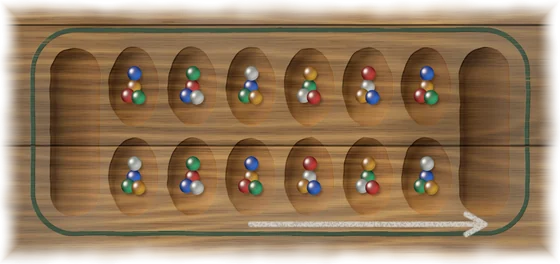
The whole mancala board with four stones in every pit. A chalk arrow runs under the bottom row from the third pit to the store at the right end.
The third pit holds four stones and is four steps from the store, so the last one lands there.

Capturing

End in an empty pit of your own and you capture. The last stone and everything in the pit straight across go to your store.

If the pit across is empty, nothing is taken. Your stone stays where it landed.

Anywhere else, the turn just ends. A last stone in a pit that already holds stones, or in one of the computer's pits, does nothing more.

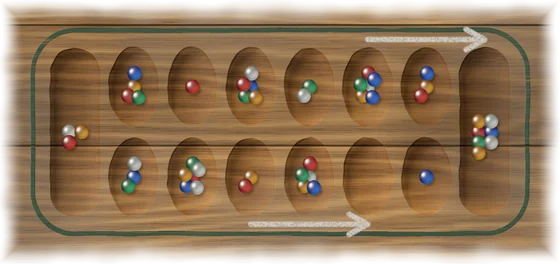
The mancala board in the middle of a game. A chalk arrow under the bottom row runs from the third pit, which holds two stones, to the empty fifth pit. A second arrow above the top row runs from the pit across from it, which holds six stones, to the store on the right.
Two stones from the third pit: the second lands in the empty fifth pit. It goes to the store, and so do the six across from it.

How a game ends

The game stops when one row is empty. It does not matter whose row it is or whose move emptied it. Whoever still has stones in their row puts them in their own store.

Most stones wins. There are 48 in the game, so 25 is enough and 24 each is a draw.

Sources

Checked against the standard rules of Kalah as Wikipedia gives them and as they are set out in Solving Kalah by Irving, Donkers and Uiterwijk (ICGA Journal, 2000), and against the engine that runs this board. The two sources differ on one point. In the paper, a last stone in an empty pit is taken even when the pit across is empty. Here, as in the rules Wikipedia gives as standard, it is not.

Questions people ask

What is the best first move?

The third pit from the left, and then the sixth. The third pit holds four stones and is four steps from your store, so the last stone lands there and you move again. Emptying the sixth pit next puts another stone in the store and leaves that pit free for later.

There are ten ways to play the first turn, counting the five moves that can follow the third pit. The engine here was given thirty seconds for each. It rated that pair best by a wide margin, and the first and second pits worst.

That matches the published solution of the game. In 2000 three researchers solved Kalah with four stones a pit by computer, and their perfect game starts with the third pit and then the sixth. Their rules differ from this board's on one small point, noted under Sources above.

Is it an advantage to go first?

Yes, and a real one. The same solution shows that the side that moves first wins if neither side makes a mistake. On this board that side is you, unless you have given the first move to the computer.

Can you get more than one extra turn?

Yes, as many as you can chain together. Every time your last stone lands in your store you go again, and nothing limits how often. Each extra move is an ordinary move: you pick any of your pits with stones in it and sow.

What if the last stone lands in a pit that already has stones?

Nothing happens, and the turn ends. You do not pick those stones up and keep going. That is the rule in some other games of the mancala family, not in this one.

Is this the capture version or the avalanche version?

Capture. Avalanche is what some phone games call the version where a last stone in an occupied pit means you lift that whole pit and go on sowing. It is a different game with different tactics, and it is not played here.

Can you capture when the last stone lands in the pit it came from?

Yes. It takes exactly thirteen stones. The sowing goes once round the board, and the last stone drops into the pit you emptied, which makes it an empty pit of your own. It captures like any other. The pit across is never empty at that point, because you have just dropped a stone there on the way round.

Who gets the stones left on the board at the end?

The player whose row they are lying in. When one row runs out, everything still in the other row goes into that row's store. So running out of stones first is not a win in itself. It can hand the computer a row full of stones it had not earned yet.

Are you allowed to count the stones?

Here you do not have to. The number of stones in every pit and in both stores is chalked on the board beside it. At a table, whether you may pick up a pile to count it is for the two players to settle before they start.

Is mancala luck or skill?

Skill. There are no dice and no cards, and nothing is hidden. Both players can see every stone, and the same move from the same position always has the same result.

Can a game end in a tie?

Yes, at 24 stones each.

What is the difference between mancala and Kalah?

Mancala is the family, Kalah is one member of it. The name covers a large group of sowing games played with pits and stones. The word comes from an Arabic root meaning to move. Kalah is the version brought out in the United States in the 1950s by William Julius Champion. When a board is sold simply as mancala, Kalah is usually the game meant, and it is the one on this page.

How games are won

Look for the free move first

A pit whose stones reach exactly to your store gives you another turn. The pit next to the store needs one stone, the one before it two, and so on. Big turns are several of these in a row.

Open with the third pit, then the sixth

Its four stones end in your store, so you move again before the computer has done anything. Then empty the sixth pit, the one beside your store.

The engine here rated four of the ten possible first turns as good for the side that starts: the third pit followed by the sixth, the fifth or the fourth, and the sixth pit played straight away. The third and then the sixth came out far ahead of the others.

Keep the pit beside your store empty

Once it is empty, every single stone that lands in it is a free move waiting: one step, into the store, and you go again. A pile of stones there is worth less, because all but the first of them sail past the store onto the computer's side.

An empty pit is a trap

Land your last stone in one and you take whatever sits across from it. Watch the computer's empty pits the same way, and move your stones out of the pits facing them.

Think before you sow a big pile

A pit with many stones goes all the way round and drops some of them on the computer's side. Sometimes that is the price of a capture. Often it is a gift.

Count the ending

The game stops the moment one row is empty, and the stones left in the other row go to their owner. A full row at that point can win the game for you, or for the computer.

Count to 25 as well. A store with 25 stones in it has won, whatever happens on the rest of the board.

Ask for a second opinion

The Hint button shows the pit the engine would play at full strength. Pick your own move first, then press it. When the two differ, play yours, watch the answer, and press Undo if you want to see the other line.

How the computer plays here

Five levels, one engine. What changes is how far it looks and how often it is allowed to be wrong.

How it thinks

The computer tries each of its pits, each answer you could give, each of its answers to those, as many turns deep as the level allows. A move that earns another move does not count as a step, so a whole chain of extra moves is seen as one turn. At the end of each line it scores the position and plays the pit that leaves it best off if you reply as well as you can.

The score is the difference between the two stores, adjusted for what is still on the board: a stone lying in its own row counts for a fifth of a stone in the store, and it adds something for every free move on offer and for the largest capture each side could make next. Once a store holds more than half the stones, it treats the game as decided.

All of this happens on your own device, in your browser.

Beginner

Sees its own turn and nothing after it. One move in five is picked at random, and the rest of the time it chooses freely among the moves it rates within a stone and a half of its best.

Easy

Sees its own turn and your answer. It is just as loose about which good move it plays, but a random move comes only about one time in twenty.

Medium

Looks four turns ahead and no longer plays random moves. It still varies, among moves within one stone of its best.

Hard

Looks six turns ahead and stays within six tenths of a stone of its best move.

Expert

Has no fixed depth. It thinks for up to 1.1 seconds and looks as far as that allows: eleven turns from the starting position on the computer where this was measured, and to the very end of the game once few enough stones are left. After the opening it always plays the best move it has found.

The levels against each other

Going first is an advantage in this game, so in every match the two levels took turns to start.

  • Easy against Beginner: 316 wins, 12 draws, 72 losses in 400 games.
  • Medium against Easy: 335 wins, 13 draws, 52 losses in 400 games.
  • Hard against Medium: 303 wins, 17 draws, 80 losses in 400 games.
  • Expert against Hard: 111 wins, no draws, 25 losses in 136 games.

Beginner and Easy make mistakes on purpose. The three levels above them never play a move at random. Measured on 9 October 2026.

What the hint is

The Hint button asks the same engine at full strength: no depth limit, half a second, never a random move. It is the Expert's opinion with less time to think.

Using it does not make the level you are playing any stronger: every search starts from nothing. Hints are counted, and the count is shown with your record at the bottom of the page.

The other barrels

Checkers is the one where a jump has to be taken, and where a piece that reaches the far row becomes a king, two pieces high.

Backgammon is a race with dice: fifteen pieces a side, and a piece left on its own can be hit and sent back to the start.

Shut the Box is nine numbered tiles and two dice: every roll has to be paid for with tiles that add up to it, and the lower sum left open wins.

Farkle is six dice and a race to 10,000: bank what a turn is worth, or roll again and risk losing all of it.

Yatzy is five dice and a scorecard, thirteen rows the American way or fifteen the Scandinavian: three rolls a turn, and every turn has to be written in a row, even when it is worth nothing there.

Dominoes is twenty-eight tiles and a line that grows at both ends: match a number, draw from the boneyard when nothing fits, and lay your last tile first.

Reversi has one kind of move: put a piece down so that it traps a row of the other color, and the row turns to yours.

Chinese Checkers is a race across a star of 121 holes: marbles hop over one another in chains, nothing is ever captured, and the first side to fill the point opposite wins.

Nine Men's Morris is the old game of mills: nine pieces a side, three in a row along a line takes a piece off, and a side left with two pieces or no move has lost.

Tic-Tac-Toe is three in a row on nine squares, and next to it Ultimate tic-tac-toe, where every square holds a small board and each move decides where the next one is played.

Four in a Row is the standing rack laid flat: seven lanes of six places, a piece slides down its lane until it is stopped, and the first side with four in a row wins.

Chess is the old game of kings: six kinds of pieces that each move their own way, and a win when the other king is attacked and cannot escape.

Gomoku is five in a row on a board of fifteen lines each way: pieces go where the lines cross, and three in a row with both ends open has to be answered at once.

Ludo is the race with one die: a six brings a piece out of its yard, landing on another color sends that piece back, and the first side with all four pieces home wins.

No games played yet.

Red for the games you won, white for the ones you lost. Your record is kept in this browser and nowhere else.

Start over?