Skip to the board
BARRELHEAD

Farkle

Your roll.

First to 10,000 wins. Roll the six dice, set aside the ones that score, then roll the rest again or bank what the turn is worth.

PointsYou:0The computer:0

Opponent
Start over?

Six dice and one decision

Farkle with the standard scoring, first to 10,000.

The dice and the goal

Six dice, two sides, first to 10,000. You and the computer take turns. A turn adds points to your score, or it adds nothing at all.

The green circle is where the dice are thrown. Dice that are set aside lie outside the painted line: yours below the circle, the computer's above it. The chalk numbers on the left are the two scores, and the number on the right is what the turn in progress is worth.

A turn

Roll all six dice. Press the word Roll painted on the lid.

Set aside at least one die that scores. The dice that score have a chalk ring. Press one and it moves outside the line. Press it again and it goes back.

Then make the one decision in the game. Bank, and the points of the turn are added to your score and the turn is over. Or roll the dice that are left, to add more.

Rolling again is a risk. If the new roll has nothing that scores, the turn ends and everything it had earned is gone.

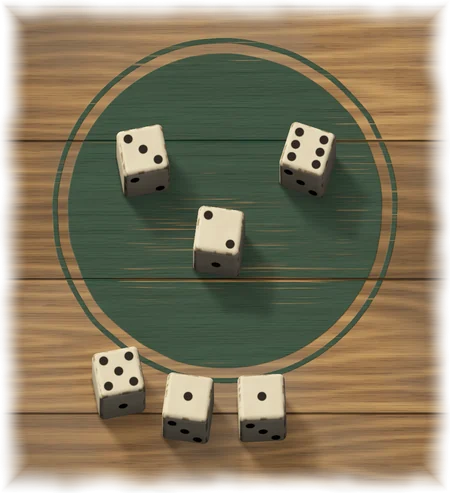
Three dice inside a circle of green paint, showing 3, 6 and 2. Below the circle, outside its painted line, three dice showing 1, 1 and 5 have been set aside.
Two 1s and a 5 are set aside, worth 250. The three dice left in the circle can be rolled again, or the 250 can be banked.

What scores

  • A single 1: 100. A single 5: 50.
  • Three 1s: 1,000.
  • Three of any other number: 100 times the number. Three 2s are 200, three 6s are 600.
  • Four of a kind: 1,000. Five of a kind: 2,000. Six of a kind: 3,000.
  • Three pairs: 1,500.
  • A straight, 1 to 6: 2,500.

Nothing else scores. A 2, a 3, a 4 or a 6 is worth something only as part of a combination.

A combination has to come in a single roll. A 5 set aside from one roll and two 5s from the next are three single 5s, 150 points, and not three of a kind.

Dice are counted the way that gives the most. Four 1s are 1,100, as three 1s and a single 1. Two sets of three in the same roll count as two threes of a kind, so three 2s and three 3s are 500.

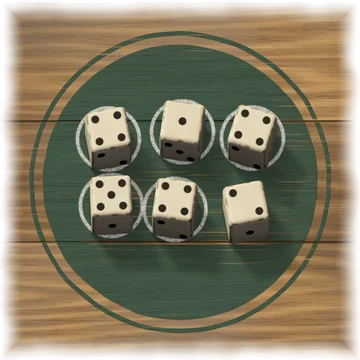
Six dice inside the green circle: a 1, a 5, three 4s and a 2. Chalk rings are drawn around the 1, the 5 and the three 4s, and none around the 2.
The 1, the 5 and the three 4s have rings: 100, 50 and 400. The 2 has none.

Farkle

A roll with nothing that scores is a farkle. The turn ends, and the points it had gathered are lost. Points you have already banked are safe.

Hot dice

When all six dice have scored, you may roll all six again. The turn goes on and its points keep adding up. There is no limit to how often it can happen in one turn, and you may also bank instead.

Winning

The first side to bank 10,000 or more sets the mark. The other side then gets one last turn, and has to finish it with a higher score to win. An equal score is not enough.

Rules that differ from table to table

Farkle is a folk game, also played as Farkel, Ten Thousand, Zilch, Zonk, Greed and Hot Dice, and the scoring changes from one kitchen table to the next. This is where the game on this page stands.

No threshold to get on the board. Many tables ask for 500 or 1,000 points in a single turn before a player may bank for the first time, and some ask for 300 or 350 in every turn. Here any score can be banked, from the first turn on.

Three pairs and the straight. Three pairs are worth 750 or 2,000 in some rules, and the straight 1,000, 1,500 or 3,000. Here they are 1,500 and 2,500.

Four, five and six of a kind. Some rules add the three-of-a-kind score once more for each extra die, others double it. Here they have set values: 1,000, 2,000 and 3,000.

No bonus for two sets of three, or for four of a kind with a pair. Some rules pay 2,500 or more for the first and 1,500 for the second. Here the dice in them score only what they are worth on their own.

Hot dice are a choice. Some rules make you roll again when all six dice have scored. Here you may bank.

No penalty for three farkles in a row. Some rules take 500 points for it.

Sources

The rules and the scoring are those given as standard in Wikipedia's article on Farkle, which takes them from Karen South Arnold's Playing Grandma's Games (2000) and lists the variations. They are checked against the engine that runs this board.

Questions people ask

What is a farkle?

A roll in which no die scores. No 1, no 5 and no combination. The turn is over, and the points gathered during it are lost.

Do you have to set aside every die that scores?

No, only at least one. Setting aside fewer dice leaves more to roll, and more dice mean a smaller risk of a farkle and a better chance of three of a kind. With a 1 and a 5 in the first roll, setting aside the 1 alone and rolling five dice is usually better than setting aside both.

Can you add a die to a combination from an earlier roll?

No. Dice set aside after one roll never combine with dice from a later roll. Each roll is scored on its own.

What are hot dice?

All six dice set aside and scoring. You pick them all up, keep the points of the turn and roll six fresh dice. It can happen with a straight, with three pairs, or bit by bit over several rolls.

Do you need a minimum score before you can bank?

Not here. Many tables play with an opening threshold of 500 or 1,000. This page does not: 50 points can be banked if you want them.

How likely is a farkle?

It depends on how many dice you roll.

  • Six dice: 2.3 percent, one roll in 43.
  • Five dice: 7.7 percent, one roll in 13.
  • Four dice: 15.7 percent, about one roll in 6.
  • Three dice: 27.8 percent.
  • Two dice: 44.4 percent.
  • One die: 66.7 percent.

These are exact, counted over every way the dice can fall with the scoring used here.

What happens when someone reaches 10,000?

The other side gets one last turn. It has to end that turn with more points than the side that got there first. In the last turn there is no reason to bank before you are ahead.

What is counted when you bank?

Every scoring die on the lid. When you press Bank, the dice that score and are still in the circle are set aside for you first. There is never a reason to leave points behind when the turn is ending anyway.

Can you take a roll back?

No. A roll stands, and so does banking. Undo here puts back the dice you have set aside since the last roll, one press at a time. You can also press a die to put it back.

Does it matter who goes first?

A little. With perfect play on both sides, the side that rolls first wins 53.2 percent of the games. The last turn makes up for some of the head start, but not all of it. On this board you roll first, unless you give the first roll to the computer under Settings.

Is farkle luck or skill?

Mostly luck in one game, and skill over many. The decisions are small: what to set aside and when to stop. The levels on this page show what they add up to. The best one beats the weakest in 82 games of 100 and the next best in 57.

Does the computer get better dice?

No. Every roll comes from the same source, whoever's turn it is, and the computer is never shown a roll before it is on the lid. How the dice are made is further down this page.

How games are won

Count the dice you are about to roll

The risk is in the number of dice, not in the points. Six dice farkle once in 43 rolls and five dice once in 13. Two dice farkle four times in nine, and a single die two times in three. Most of the game is deciding whether the points on the lid are worth that risk.

Set aside less than you could

A lone 5 is worth 50 points and costs you a die. Early in a turn the die is worth more. From a first roll with a 1 and a 5, keep the 1 and roll five dice: the chance of a farkle is 7.7 percent with five dice and 15.7 percent with four.

The same goes for two 1s: on a first roll, one of them is enough. Even three 2s lying beside a 1 are better left in the circle. Their 200 points are not worth giving up three dice for.

Know where to stop

Playing for the most points per turn, without looking at the score, the exact answer for these rules is to bank once the turn is worth this much:

  • Two dice left: 300.
  • One die left: 350.
  • Three dice left: 450.
  • Four dice left: 1,050.
  • Five dice left: 3,100, which almost never comes up.
  • Six dice left: never. Roll them.

One die is worth rolling a little longer than two because a hit gives you hot dice and six fresh dice. Played this way a turn brings in about 600 points on average, and a bit more than one turn in five ends in a farkle.

Then look at the score

Those numbers are for the long run. Late in a game the score matters more. Far behind, bank later than the list says: safe turns will not catch up. Well ahead, bank sooner and make the other side take the risks.

Mind the last turn

Reaching 10,000 does not end the game. It hands the other side one turn with nothing to lose, in which it will roll until it passes you or farkles. A narrow lead at the finish is beaten more often than it feels like it should be, so a wide one is worth an extra roll when the dice left make that cheap.

Ask for a second opinion

The Hint button shows what the computer would do at full strength with the roll on the lid: which dice to set aside, and whether to roll again or bank. It plays the score, so its advice late in a game can differ from the list above.

How the computer plays here

Five levels. The best one plays the exact best move, and each of the other four makes a mistake that people make.

How it thinks

Farkle can be solved. For every pair of scores, the chance of winning at the start of a turn has been worked out ahead of time and is stored with the page. During a turn the engine works backward from that table through every roll that could follow, and so it knows the exact chance of winning after each choice: every set of dice it could set aside, with and without banking.

The method is checked against the published figures in Optimal Play of the Farkle Dice Game by Matthew Busche and Todd Neller (2017). Given the simpler rules of that paper, the engine arrives at the same numbers: 446.57 points per turn for a player who plays for points, a farkle in 20.60 percent of those turns, and a win for the first player in 53.70 percent of games. The same code then plays the rules on this page.

All of it happens on your own device, in your browser.

Beginner

Sets aside everything that scores and never banks less than 1,000. It waits too long: about seven of its turns in ten end in a farkle.

Easy

Sets aside everything that scores and banks as soon as the turn is worth 300, however many dice are left. Too careful, and it never builds a big turn.

Medium

Banks later the more dice it has left, which is the right idea: at 300 with one or two dice, 350 with three, 500 with four, 800 with five and 1,500 with six. But it still sets aside every die that scores instead of saving dice for the next roll.

Hard

Works out the exact number of points each choice is worth on average, and often sets aside fewer dice than it could. Its fault is fear: it counts a farkle as 750 points worse than it is, so it banks too early. It does not look at the score.

Expert

Plays for the chance of winning the game, worked out exactly. It takes risks when it is behind, plays safe when it is ahead, and knows when stopping just short of 10,000 is better than handing you a last turn.

The levels against each other

Each level has played the one below it 20,000 times. The games were played in pairs with the same dice and the seats swapped, so neither side could simply be luckier.

  • Easy against Beginner: 68.0 percent.
  • Medium against Easy: 56.8 percent.
  • Hard against Medium: 59.9 percent.
  • Expert against Hard: 57.1 percent.
  • Expert against Beginner: 82 percent.

The steps are small because the dice decide so much. Farkle is a game of luck in which the best play loses often: 43 games in 100 against the level below it. Measured on 9 October 2026.

What the hint is

The Hint button asks the engine at Expert's strength. It is the choice with the best chance of winning the game, which is not always the one that brings in the most points.

How the dice are rolled

When a game starts, the page draws one random number. Every roll in that game is worked out from that number and the number of the roll: the first roll of the game, the second, and so on, whoever makes it. The code that makes the roll does not know which side it is for.

The computer is handed the scores and the roll that is on the lid, and nothing else. It never sees a roll that has not been thrown yet, its own included. A roll is never taken back either, so there is no way to fish for a better one.

On 9 October 2026 the generator was run for 2 million rolls of six dice, 12 million dice in all. Each of the six faces came up between 16.65 and 16.68 percent of the time, where a perfect die gives 16.67. The average die showed 3.500 on odd-numbered rolls and 3.499 on even-numbered ones, against the 3.5 that fair dice give.

Why fair dice still feel unfair

The rolls you remember are the ones that cost you something. A farkle with two dice happens four times in nine, and it wipes out a turn that had already taken several good rolls to build. The good rolls before it do not feel like luck. The bad one does.

Rare things also happen in a long game. A farkle with all six dice comes once in 43 rolls, and every turn begins with a roll of all six. A game usually runs to thirty turns or more between the two sides, and over thirty such rolls it is as likely as not to happen to someone.

The other barrels

Checkers is the one where a jump has to be taken, and where a piece that reaches the far row becomes a king, two pieces high.

Backgammon is a race with dice: fifteen pieces a side, and a piece left on its own can be hit and sent back to the start.

Shut the Box is nine numbered tiles and two dice: every roll has to be paid for with tiles that add up to it, and the lower sum left open wins.

Yatzy is five dice and a scorecard of thirteen rows: three rolls a turn, and every turn has to be written in a row, even when it is worth nothing there.

Reversi has one kind of move: put a piece down so that it traps a row of the other color, and the row turns to yours.

Mancala has no dice and nothing hidden: you empty a pit, sow its stones round the board one at a time, and count what ends up in your store.

Chinese Checkers is a race across a star of 121 holes: marbles hop over one another in chains, nothing is ever captured, and the first side to fill the point opposite wins.

Nine Men's Morris is the old game of mills: nine pieces a side, three in a row along a line takes a piece off, and a side left with two pieces or no move has lost.

Tic-Tac-Toe is three in a row on nine squares, and next to it Ultimate tic-tac-toe, where every square holds a small board and each move decides where the next one is played.

No games played yet.

Red for the games you won, white for the ones you lost. Your record is kept in this browser and nowhere else.

Start over?