Skip to the board
BARRELHEAD

Chinese Checkers

Your move.

You play red and go first, from the bottom point to the top one. Pick a marble, then a hole it can reach.

Your marbles home:0The computer's marbles home:0

Opponent
Start over?

Five rules and a star

Chinese checkers for two, the way this board plays it.

The board and the marbles

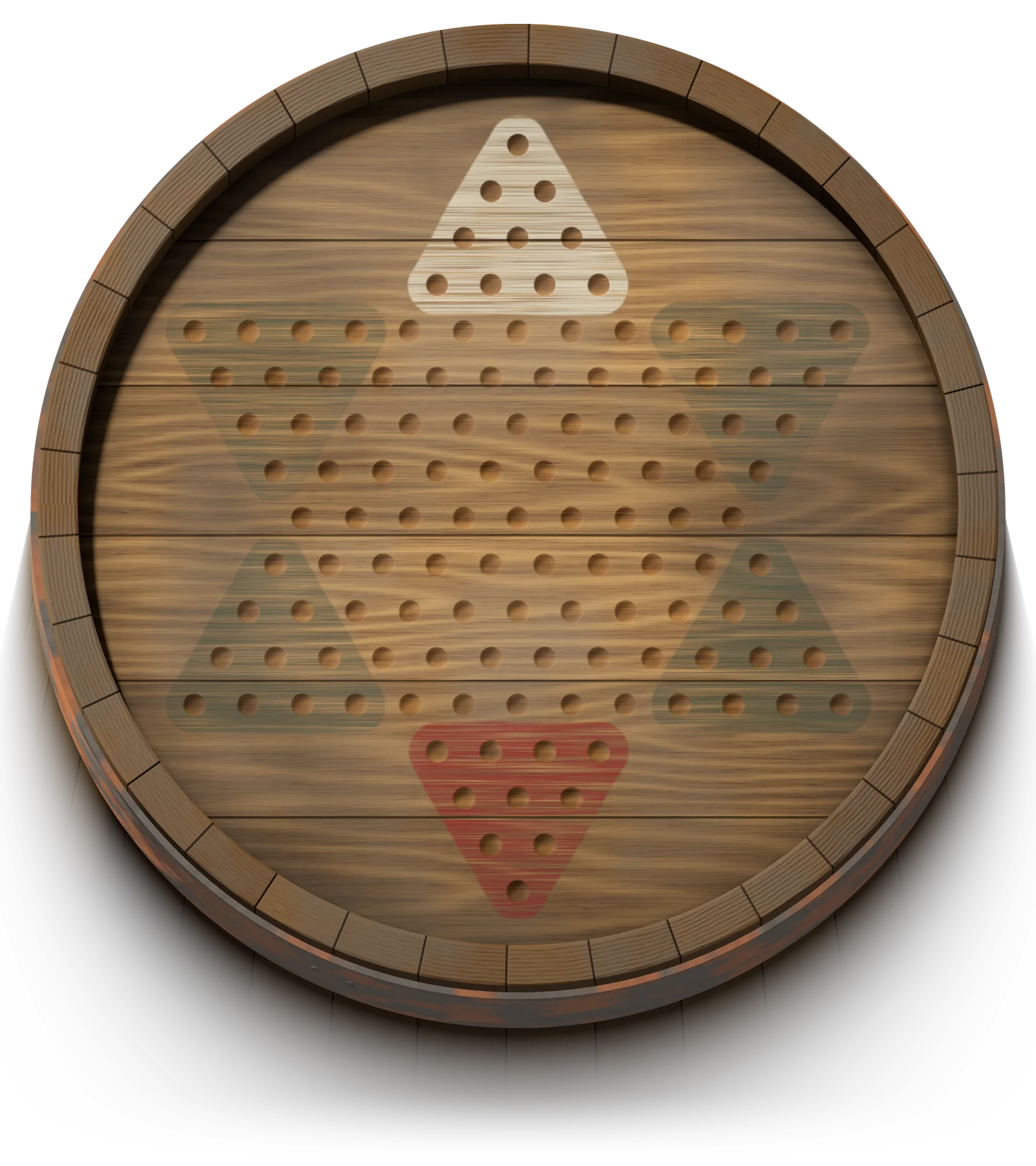
The board is a six-pointed star of 121 holes. Each point is a triangle of ten holes, and the 61 holes in the middle belong to nobody.

Each side has ten marbles. Yours are the red ones and start in the bottom point, which is painted red. The computer has the white ones in the top point, painted white.

The other four points start empty. With two players nobody lives there. They are open ground like the middle of the board.

You move first, unless you give the first move to the computer under Settings. After that the two sides take turns, one marble each.

The aim

Get all ten marbles into the point opposite. Yours go from the bottom point to the top one, the computer's the other way. The first side to fill its point wins, and the game stops there.

Stepping and hopping

A move is one marble. It either steps or hops, never both in the same move.

A step goes to an empty hole next door. Every hole has up to six neighbors, and a marble may step to any of them: forward, sideways or back.

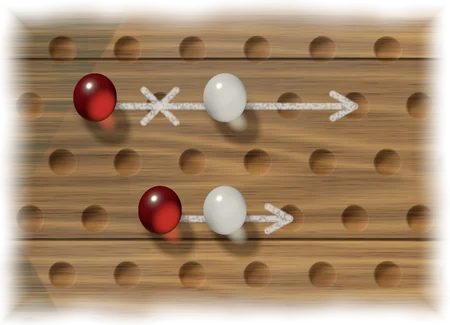
A hop goes over one marble and lands right behind it. The marble hopped over has to be in the very next hole, and the hole straight beyond it has to be empty. It can be one of yours or one of the computer's.

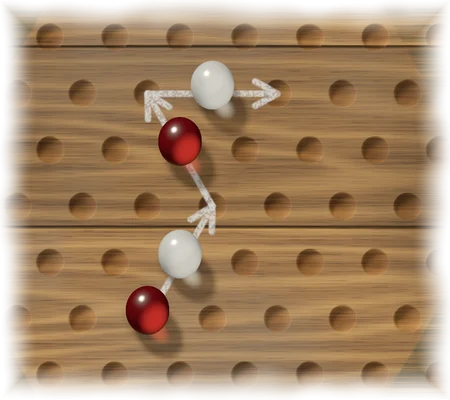
Hops can be chained. After landing, the same marble may hop again from where it stands, in any direction, as many times as there is something to hop over. The whole chain is one move.

Nothing is forced. You never have to hop, and you can stop a chain after any landing.

Nothing is captured. A marble that is hopped over stays where it is. All twenty marbles are on the board from the first move to the last.

The middle of the board with two red and two white marbles. Chalk arrows show one red marble hopping over a white marble, then over the other red marble in a new direction, then sideways over the second white marble.
Three hops, one move: over a white marble, over a red one, and sideways over another white one.
Two rows of holes. In the lower row a red marble hops over a white marble in the next hole, shown by a chalk arrow. In the upper row there is an empty hole between the red marble and the white one, and the arrow over them is crossed out.
The lower hop is fine. The upper one is not: there is an empty hole between the two marbles.

Where a marble may go

Anywhere on the star. A marble may pass through any of the six points and may stop in any of them, including the four that start empty and the point it came from.

Only one marble fits in a hole. A step or a hop always ends in an empty one.

How a game ends

A full point wins. The moment all ten holes of your point are taken, the game is yours.

A marble left behind does not block. If the computer leaves one of its marbles in your point, you do not need that hole. The point counts as full when every hole in it is taken and at least one of the marbles is yours. The same goes for a marble you leave at home.

A game cannot go on forever. If each side has made 150 moves and neither point is full, the game is called. The side with more marbles in its point wins. If that is level, the side whose marbles have less way left wins, counted in rows from the tip of its point. If that is level too, it is a draw.

If you cannot move, you sit out. A side with no marble that can step or hop passes, and the other side plays again. It takes a very cramped position for that to happen.

Sources

The moves are checked against The Rules of Chinese Checkers from Masters Traditional Games, and against the engine that runs this board. Two rules above are this site's own. Printed rules mostly leave out what happens when a marble is left sitting in the other side's point. Masters Traditional Games mentions the fix used here, a win once every available hole is filled, among several that have been proposed. This board adds that at least one marble in the point has to be the winner's. The limit of 150 moves each, and the way a game is settled when it is reached, are this board's own.

Questions people ask

Is Chinese checkers from China?

No, and it is not checkers either. The game was invented in Germany in 1892 under the name Stern-Halma, star Halma, as a version of the older American game Halma played on a star. The name Chinese checkers came with an American edition in 1928 and was a piece of marketing.

It has little in common with checkers beyond the hop: nothing is taken off the board and nothing is crowned.

What is a good first move?

A hop out of the second row. There are fourteen first moves: eight steps by the four marbles in the front row of your point, and six hops over them by the three marbles in the row behind.

Asked for its first move at full strength, the engine here takes an outer marble from that row of three and hops it over the front row, into the hole straight in front of the middle of the point. The same hop from the other side is its mirror image.

Can I hop over my own marbles?

Yes. A hop goes over whatever marble is in the next hole, red or white. Most long chains use both.

Do I have to hop when I can?

No. A hop is never forced, and neither is the rest of a chain. You can stop after any landing, or step with another marble altogether.

Can a marble move backward?

Yes. Steps and hops go in all six directions. A hop back or sideways in the middle of a chain is often what lets the chain go on.

Can a marble hop over two marbles, or over a gap?

No. A hop clears exactly one marble, the one in the next hole, and lands in the hole right behind it. Two marbles in a row cannot be hopped, and neither can a marble with an empty hole in front of it.

There is a faster game, often called Super Chinese Checkers, where a marble may leap over a single marble any distance away and land the same distance beyond. That game is not played here.

Can a marble stop in the empty side points?

Here, yes. With two players the four side points belong to nobody, so they are ordinary holes. Some rule sets written for more players forbid ending a move in a point that is someone else's home or target.

It is rarely a good place to stand. The straight road between your point and the computer's runs through the middle.

What if the computer leaves a marble in my point?

Then nine holes are enough. You win when every hole in your point is taken and at least one marble there is yours, so a marble the computer never moves does not keep you out. It works the same way against you: a marble you leave at home does not stop the computer.

Leaving one behind is not a free defense either. That marble still has the whole board to cross if the game goes to the move limit, where marbles home are what is counted.

Ten marbles or fifteen?

Ten here. Some rule sets give each side fifteen marbles when only two play. This board plays the ten-marble game, the same one that is played with three to six people.

How long is a game?

About fifty moves each. In 100 games the engine played against itself at Hard, the shortest was over after 79 moves, counting both sides, and the longest took 117. The average was 98.

The shortest game anyone can play is 30 moves, 15 on each side, and it takes two players working together to do it. David Fabian found such a game in 1979, and in 2008 George Bell showed by computer search that none is shorter. A single set of ten marbles crossing an otherwise empty board needs 27 moves.

Does it matter who goes first?

A little. The game is a race, and the first move is a head start of one move. When the engine played itself at Hard, the side that moved first won 104 games of 200. At Medium it won 214 of 400, and at Easy 235 of 400.

Can a game end in a draw?

Only on paper. A draw needs 150 moves each, the same number of marbles home and the same way left for both sides. In the 1,900 games the engine played against itself for this page, no game even reached the limit: somebody always filled a point first.

The holes are small. Do I have to hit them exactly?

No. A tap counts for the nearest hole. Once you have picked a marble, a tap that lands on a hole it cannot use is pulled to the nearest chalk dot, if one is close by. Tapping the picked marble again puts it back.

With a keyboard, the arrow keys walk from hole to hole and Enter picks a marble. After that the arrows go between the holes that marble can reach, Enter plays the move, and Escape puts the marble back.

Can two people play on this board?

Yes. Pick Two players under Opponent. Red sits at the bottom and white at the top, both sides are moved by tapping, and the computer stays out of it. Those games are not counted in your record.

Sources

The history, and the fifteen-marble game for two, are from the Wikipedia article on Chinese checkers and from Masters Traditional Games, linked above. The shortest games are from The shortest game of Chinese Checkers and related problems by George I. Bell (Integers, 2009).

How games are won

Build a ladder, then climb it

A step moves a marble one hole. A hop moves it two, and a chain of hops moves it two holes for every marble in its way. The whole game is arranging marbles with one empty hole between them, so that the next marble can run up the line.

In 100 games between two Hard levels, nearly six moves in ten were hops. The longest chain was nine hops in a single move, and one move carried a marble fourteen rows up the board. The whole board is seventeen rows.

Go through the middle

From the tip of one point to the tip of the other is sixteen steps in a straight line. Every hole a marble drifts toward the side points is a hole it has to come back.

The engine measures exactly this: for each marble, the number of steps left to the tip of the point it is going to.

Leave nobody behind

The marbles that set up the ladder are the last ones to use it. A marble left alone at the back has nothing to hop over and walks the whole way one hole at a time, while the computer is still hopping.

The engine charges itself extra for this. The cost of a marble grows faster than its distance, so moving the one at the very back is worth more to it than moving one that is nearly home. Beginner and Easy play without that charge. It is one of the two things that separate them from Medium.

Your ladder is the computer's ladder

A hop goes over either color. A line of marbles you have spaced out across the middle carries the computer's marbles toward your home as well as yours toward its home.

Before you leave a marble in the middle, look at what it lets the other side hop over. From Medium up, the computer looks at your best reply before it moves.

Fill the point from the tip

The last few moves are easy to waste. A marble that stops in the front row of the point is in the way of the ones behind it, and the holes at the tip can only be reached by going past it.

Send the first marbles in as deep as they will go. Close to its point the engine no longer measures straight to the tip. For a marble still outside, it counts the steps to an empty hole in the point and on from that hole to the tip.

Count the race

Once the two groups have passed each other there is nothing left to hop over except your own marbles, and nothing the other side can do to you. From there the game is arithmetic: who needs fewer moves to get everyone in.

The engine changes its search at that point. It stops looking at replies, looks only at its own moves, and gets twice as far ahead in the same time.

How far a simple plan gets you

One plan was tried here against the levels: always move the marble that gains the most ground, by a step or by a chain of up to three hops, and never look ahead or back.

  • Against Beginner: 773 wins and 227 losses in 1,000 games.
  • Against Easy: 187 wins and 213 losses in 400 games.
  • Against Medium: 21 wins and 379 losses in 400 games.

Chasing the longest hop is enough for Beginner and an even match for Easy, which plays the same way. Medium keeps its marbles together and looks at your reply, and against that the plan falls apart.

Ask for a second opinion

The Hint button rings the marble the engine would move at full strength, and the hole it would land in. Pick your own move first, then press it. When the two differ, play yours, watch the answer, and press Undo if you want to see the other line.

How the computer plays here

Five levels, one engine. The top two are a long way above the rest, so start low.

How it thinks

The computer tries its moves, your answers and its answers to those, as many moves deep as the level allows. A whole chain of hops counts as one move. At the end of each line it scores the position and plays the move that leaves it best off if you reply as well as you can.

The score is a race count. For each side it adds up how far every marble still has to go, with the extra charge for marbles far behind, and compares the two sums. There is nothing in it about blocking you.

A position often has more than a hundred legal moves, most of them steps backward or sideways that nobody would play. Past the first move of a line the search follows only the dozen moves that gain the most ground.

All of this happens on your own device, in your browser.

Beginner

Looks at its own move and nothing after it, and sees chains of three hops at most. It is content with a move that gains one hole less than its best, and about one move in twenty it sees only steps and single hops. It does not mind leaving marbles behind.

Easy

Sees every chain, and plays the move that gains the most ground or very nearly. It still looks at nothing but its own move, and it still leaves its last marbles at the back with nothing to hop over.

Medium

Keeps its group together and counts your best reply to each of its moves. About one move in four it slips and plays the way Easy does, seeing chains of three hops at most.

Hard

Looks two moves ahead: it sets a marble down in one move so that another can hop over it in the next, and it sees you doing the same. About one move in five it slips, back to Easy with chains of four hops at most.

Expert

Has no fixed depth. It thinks for up to a second, about 0.7 seconds on the computer where this was measured, and looks about seven moves ahead in that time. After the first three moves it always plays the best move it has found.

The levels against each other

Each level has played the level below it from the starting position, taking turns to move first.

  • Easy against Beginner: 839 wins and 161 losses in 1,000 games.
  • Medium against Easy: 936 wins and 64 losses in 1,000 games.
  • Hard against Medium: 393 wins and 7 losses in 400 games.
  • Expert against Hard: 24 wins in 24 games.

The steps are steeper here than in the other games on this site. There are no dice and no draws, and nothing is ever captured back, so a side that moves a little better at every turn wins almost every time. Hard and Expert are for players who already beat Medium. Measured on 9 October 2026.

What the hint is

The Hint button asks the same engine at full strength: no depth limit, up to a second, never a random move and never a slip. It is Expert without the variety Expert allows itself in its first three moves.

Using it does not make the level you are playing any stronger: every search starts from nothing. Hints are counted, and the count is shown with your record at the bottom of the page.

The other barrels

Checkers is the one where a jump has to be taken, and where a piece that reaches the far row becomes a king, two pieces high.

Backgammon is a race with dice: fifteen pieces a side, and a piece left on its own can be hit and sent back to the start.

Shut the Box is nine numbered tiles and two dice: every roll has to be paid for with tiles that add up to it, and the lower sum left open wins.

Farkle is six dice and a race to 10,000: bank what a turn is worth, or roll again and risk losing all of it.

Yatzy is five dice and a scorecard of thirteen rows: three rolls a turn, and every turn has to be written in a row, even when it is worth nothing there.

Reversi has one kind of move: put a piece down so that it traps a row of the other color, and the row turns to yours.

Mancala has no dice and nothing hidden: you empty a pit, sow its stones round the board one at a time, and count what ends up in your store.

Nine Men's Morris is the old game of mills: nine pieces a side, three in a row along a line takes a piece off, and a side left with two pieces or no move has lost.

Tic-Tac-Toe is three in a row on nine squares, and next to it Ultimate tic-tac-toe, where every square holds a small board and each move decides where the next one is played.

No games played yet.

Red for the games you won, white for the ones you lost. Your record is kept in this browser and nowhere else.

Start over?