Skip to the board
BARRELHEAD

Yatzy

Your roll.

Thirteen turns each. Roll the five dice up to three times, keeping the ones you want, then write the roll in one row. The higher total wins.

TotalYou:0The computer:0

Opponent
Start over?

Five dice and thirteen rows

Yatzy with the rules most often played in the United States: thirteen rows, a bonus for the upper six, and a joker rule for a second five of a kind.

The dice and the goal

Five dice, two scorecards, thirteen turns each. You and the computer take turns. Every turn ends with one row of your card filled in, and when both cards are full the higher total wins.

This is the five-dice game known under several trade names, played here with the rules that are most common in the United States.

The green field is where the dice are thrown. Dice you keep lie below it, inside the painted line with the word Keep. The chalk strokes beside the word Roll are the rolls you have left in the turn.

The scorecard is not on the lid. It stands next to the barrel, or under it on a phone. Your column is the one under the red piece, the computer's the one under the white piece.

A turn

Roll all five dice. Press the word Roll painted on the lid.

Keep the dice you like. Press a die and it moves below the field and gets a chalk frame. Press it again and it goes back. Any die can be kept or put back between rolls, also one you kept after the first roll.

Roll the others again, up to three rolls in all. You may stop after the first roll or the second.

Then write the roll in one row. Every open row on your card shows what the dice on the lid would score there, in a lighter tone than the scores already written. Press a row and the number is written in. Each row is used once.

A turn always fills a row. If the roll fits nowhere you still have to pick one, and take a zero in it.

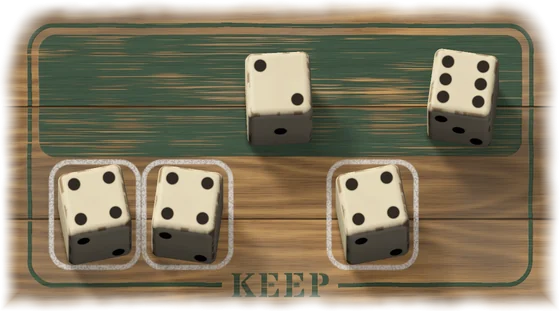
Five dice on the lid. A 2 and a 6 lie on the field of green paint. Below the field, inside a painted line with the word Keep in it, lie three dice showing 4, each with a chalk frame around it.
Three 4s are kept below the field. The 2 and the 6 are still on it, and the next roll throws only those two.

The upper section

Six rows, one for each number. Ones scores the sum of the dice showing 1, Twos the sum of the dice showing 2, and so on up to Sixes. Three 4s and two other dice are 12 in Fours.

63 or more in these six rows earns a bonus of 35. Three dice of each number is exactly 63. The Bonus row shows the sum so far, for both sides.

The lower section

  • 3 of a kind: at least three dice the same. The sum of all five dice.
  • 4 of a kind: at least four dice the same. The sum of all five dice.
  • Full house: three of one number and two of another. 25.
  • Small straight: four numbers in a row, such as 2, 3, 4 and 5. 30.
  • Large straight: five numbers in a row, 1 to 5 or 2 to 6. 40.
  • Yatzy: five dice the same. 50.
  • Chance: any roll at all. The sum of all five dice.

A roll can go in any open row. If it is not what the row asks for, it scores zero there.

A roll can be right for more than one row. A large straight is also a small straight, and four of a kind is also three of a kind. Five of a kind counts as three and as four of a kind, but not as a full house, which needs two different numbers.

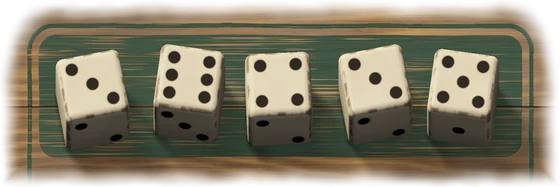
Five dice on the field of green paint, showing 3, 6, 4, 3 and 5.
A small straight: 3, 4, 5 and 6 are four numbers in a row. The fifth die can show anything.

More than one Yatzy

The first five of a kind belongs in the Yatzy row, for 50. While that row is open, five of a kind is a roll like any other: it can go there, or in another row by the ordinary rules.

Each one after that brings a bonus of 100, as long as the Yatzy row holds its 50. If you wrote a zero in the Yatzy row, later ones bring no bonus.

It still has to be written in a row, and the joker rule says which.

  • First: the upper row for its number, if that row is open. Five 4s go in Fours, for 20.
  • If that row is filled: any open row in the lower section. There it is a joker and scores the row in full: 25 as a full house, 30 as a small straight, 40 as a large straight, and the sum of the dice in 3 of a kind, 4 of a kind and Chance.
  • If the lower section is full as well: any open upper row, where it scores zero.

The rows the rule does not allow show no number, and the line under the status says where the roll has to go. The bonus is written under the 50 in the Yatzy row.

The end of the game

The game is over when both cards are full, after thirteen turns each. The total is every row added up, plus 35 if the upper section reached 63, plus 100 for each Yatzy after the first.

The higher total wins. Equal totals are a draw. The game is played to the last row even when one side can no longer be caught.

Rules that are not played here

The game is played by more than one set of rules. These are the two that differ most from the game on this page. Neither can be chosen here yet.

The free joker. In some rules a second Yatzy may be written in any open row. A full house or a straight then scores in full only if the upper row for the number is already filled, and zero otherwise. Here the joker rule decides the row.

The Scandinavian game. The game the Nordic countries know as Yatzy has fifteen rows instead of thirteen. It adds One pair and Two pairs, scores three and four of a kind as the sum of just those dice, a full house as the sum of its five dice, and the straights as 15 for 1 to 5 and 20 for 2 to 6. Its upper bonus is 50, and there is no bonus for a second five of a kind.

Sources

The rules played here are the ones given as standard for the American game in Wikipedia's article on it and on Tom Verhoeff's rules page at Eindhoven University of Technology: thirteen rows, 35 for 63 in the upper section, 100 for each five of a kind after one scored as 50, and the joker rule that decides the row. They are checked against the engine that runs this board. The Scandinavian rules are from Wikipedia's article on Yatzy.

Questions people ask

How many rolls do you get in a turn?

Up to three. The first is always all five dice. After it you may roll any of them again, twice at most. You can stop and write the roll in after any of the three.

Can you put back a die you kept?

Yes, as long as you have a roll left. Keeping a die is not final. Between rolls every die can be moved either way, also the ones that sat out the last roll.

What if the roll fits nowhere?

You take a zero. Every turn fills a row, so a roll that scores nothing in any open row still has to go somewhere. Which row to give up is one of the real decisions in the game.

How do you get the 35 bonus points?

By reaching 63 in the six upper rows. That is three dice of each number, but it does not have to come that way. Four 6s make up for a pair of 3s that never came.

Does five of a kind count as a full house?

Not on its own. A full house is three of one number and two of another. As a joker it does: a second Yatzy written in the Full house row scores 25.

Does a large straight count as a small straight?

Yes. Five numbers in a row hold four in a row, so the roll can be written in Small straight for 30 when Large straight is taken.

What is a second Yatzy worth?

100 bonus points, plus the row it is written in. The bonus is paid only if the first one scored 50 in the Yatzy row.

How likely is a Yatzy?

About 4.6 percent in a turn spent going for it, or one such turn in 22. That is with all three rolls, keeping the number you have most of each time. In a single roll of five dice it is one in 1,296.

What are the odds on the first roll?

  • Three of a kind or better: 21.3 percent.
  • A small straight or better: 15.4 percent.
  • A full house: 3.9 percent, one roll in 26.
  • A large straight: 3.1 percent, one roll in 32.
  • Four of a kind or better: 2.0 percent.

These are exact, counted over all 7,776 ways five dice can fall.

What is a good score?

Around 250 is what flawless play averages. The exact figure for these rules is 254.59. The weakest level on this page averages about 199 and the strongest about 254, so a total over 250 is a good game whoever plays it.

What is the highest score possible?

1,575. It takes five of a kind in all thirteen turns: 375 in the rows and the upper bonus, and twelve bonuses of 100.

Can you take a roll back?

No. A roll stands. Undo here puts back the dice you have moved since the last roll, one press at a time. It also takes back a row you have just written in, but only until the computer has rolled.

Does it matter who goes first?

Hardly. Each side fills its own card, and nothing one side does changes the other side's dice. The side that goes second does know, in its last turn, exactly what it has to beat. On this board you roll first, unless you give the first turn to the computer under Settings.

Is it luck or skill?

Mostly luck in one game, and skill over many. Even with flawless play the total swings by about 60 points from one game to the next. The levels on this page show what the decisions add up to: about 55 points a game between the weakest and the strongest, and each level beats the one below it in roughly six games of ten.

Does the computer get better dice?

No. Every roll comes from the same source, whoever's turn it is, and the computer is never shown a roll before it is on the lid. How the dice are made is further down this page.

How games are won

Play for the bonus

The 35 points for the upper section are the easiest points in the game to lose without noticing. The mark to measure against is three dice of each number: 3 in Ones, 6 in Twos, 9 in Threes, 12 in Fours, 15 in Fives and 18 in Sixes.

Keep count of whether you are ahead of that or behind it. Four of a number puts you ahead and two puts you behind, and the high numbers move the sum most.

Keep what you have most of

Early in a game, with most rows open, the dice worth keeping are usually the ones that match. A pair or better feeds several rows at once: the upper row for that number, 3 of a kind, 4 of a kind, the full house and the Yatzy.

Count the ways to finish a straight

Four numbers in a row that are open at both ends, like 2, 3, 4 and 5, become a large straight with a 1 or a 6. That is one chance in three on a roll, and 56 in 100 with two rolls.

Four that can be finished by one number only, like 1, 2, 3 and 4, or 2, 3, 5 and 6 with the 4 missing, have one chance in six on a roll and 31 in 100 with two. The small straight is already made in the first case, so the roll costs nothing. In the second it is all or nothing.

Two pairs are a full house in waiting

With two pairs on the lid, the fifth die makes a full house one roll in three. With two rolls left it comes 56 times in 100.

Choose where the zero goes

Sooner or later a roll fits nowhere. Early on, the cheapest row to give up is Ones: the most it can ever hold is 5, and the bonus count misses it least. Late in a game it is often the Yatzy row, which pays in only one turn in 22 even when all three rolls are spent on it.

Do not close the Yatzy row early

A Yatzy is worth more than its 50. With the 50 written in, every later five of a kind pays 100 on top of the row it goes in. A zero in the Yatzy row ends that for the rest of the game.

Keep Chance in reserve

Chance takes any roll at its full sum. It is worth most as the place for a turn that went wrong with high dice on the lid: a straight that did not come, three of a kind that stayed a pair. Filled early with a middling roll, it is gone when you need it.

Then look at the other card

All of this is about getting the most points on average. Near the end the other card matters too. Behind with two turns left, a safe 20 does not help: play for the row that can still catch up. Ahead, take the points that are certain.

Ask for a second opinion

The Hint button shows what the computer would do at full strength with the dice on the lid: which of them to keep, or which row to write the roll in. It plays for the highest total it can expect and does not look at the other card, so at the end of a close game your own judgment may be the better one.

How the computer plays here

Five levels. The best one plays for the highest total it can expect, and each of the other four makes a mistake that people make.

How it thinks

Each side fills its own card, so for one player the game can be worked out exactly: for every state a scorecard can be in, what the final total will be on average with perfect play from there. For these rules that average is about 254.59 points, counted from an empty card.

The engine makes the same kind of calculation. With a roll on the lid it goes through every way of keeping dice and every row the roll could be written in, and works out what each is worth by the end of the game. The top level counts four of its own turns in full, the one in progress included, and estimates the rows that are left after them. Once no more than seven rows are left open, it plays the rest of the game exactly.

Measured on 600 scorecards, the top level gives up 0.38 points a game against perfect play.

The computer plays its own card. It does not look at yours, so it does not gamble when it is behind or play safe when it is ahead.

All of it happens on your own device, in your browser.

Beginner

Keeps the dice of the number it has most of and rolls the rest, takes a full house or a straight when one turns up, and writes the roll in wherever it scores most right now. It averages about 199 points a game.

Easy

Works out the odds on the dice exactly, but only for the points of the turn in progress. It spends good rows on middling rolls and never thinks about the bonus. About 218 points a game.

Medium

Knows that a row can be worth more later, but counts that at less than half of what it is really worth, and leaves the upper bonus out of the calculation. About 229.

Hard

Counts almost in full what the open rows are worth later, but still leaves the bonus out, and reaches it in only one game in six. About 241.

Expert

Plays for the highest total it can expect, the bonus included. About 254 points a game.

The levels against each other

Each level has played the one below it: 4,000 games for each step, and 1,000 for the top one.

  • Easy against Beginner: 67.2 percent.
  • Medium against Easy: 58.9 percent.
  • Hard against Medium: 58.7 percent.
  • Expert against Hard: 57.6 percent.

The steps are small because the dice decide so much. A dozen points a game is a large edge in a game whose total swings by about 60, and the best play still fails to beat the level below it in more than four games of ten.

What the hint is

The Hint button asks the engine at Expert's strength. It is the choice with the highest total to expect at the end of the game: which dice to keep, or which row to fill.

How the dice are rolled

When a game starts, the page draws one random number. Every roll in that game is worked out from that number and the number of the roll: the first roll of the game, the second, and so on, whoever makes it. The code that makes the roll does not know which side it is for.

The computer is handed the scorecards and the dice that are on the lid, and nothing else. It never sees a roll that has not been thrown yet, its own included. A roll is never taken back either, so there is no way to fish for a better one.

On 9 October 2026 the generator was run for 2 million rolls of five dice, 10 million dice in all. Each of the six faces came up between 16.65 and 16.68 percent of the time, where a perfect die gives 16.67. The average die showed 3.500 on odd-numbered rolls and 3.500 on even-numbered ones. Five of a kind in a single roll came up 1,515 times, where fair dice give 1,543 on average.

Why fair dice still feel unfair

The rolls you remember are the ones that cost you something. A straight that needs one exact number misses with two rolls 69 times in 100, and it feels like bad luck every time. The three 6s that came on the first roll of the turn before felt like good play.

Rare things also happen in a long game. Each side rolls up to 39 times, and the computer will now and then get a Yatzy at the moment you least want it to. It gets them at the same rate you do.

The other barrels

Checkers is the one where a jump has to be taken, and where a piece that reaches the far row becomes a king, two pieces high.

Backgammon is a race with dice: fifteen pieces a side, and a piece left on its own can be hit and sent back to the start.

Shut the Box is nine numbered tiles and two dice: every roll has to be paid for with tiles that add up to it, and the lower sum left open wins.

Farkle is six dice and a race to 10,000: bank what a turn is worth, or roll again and risk losing all of it.

Reversi has one kind of move: put a piece down so that it traps a row of the other color, and the row turns to yours.

Mancala has no dice and nothing hidden: you empty a pit, sow its stones round the board one at a time, and count what ends up in your store.

Chinese Checkers is a race across a star of 121 holes: marbles hop over one another in chains, nothing is ever captured, and the first side to fill the point opposite wins.

Nine Men's Morris is the old game of mills: nine pieces a side, three in a row along a line takes a piece off, and a side left with two pieces or no move has lost.

Tic-Tac-Toe is three in a row on nine squares, and next to it Ultimate tic-tac-toe, where every square holds a small board and each move decides where the next one is played.

No games played yet.

Red for the games you won, white for the ones you lost. Your record is kept in this browser and nowhere else.

Start over?