Skip to the board
BARRELHEAD

Checkers

Your move.

You play red and go first. Tap a piece, then the square it moves to: one step diagonally forward.

How to play
Opponent
Start over?

The rules, start to finish

American checkers, as it is played at tournaments and on front porches.

The board and the pieces

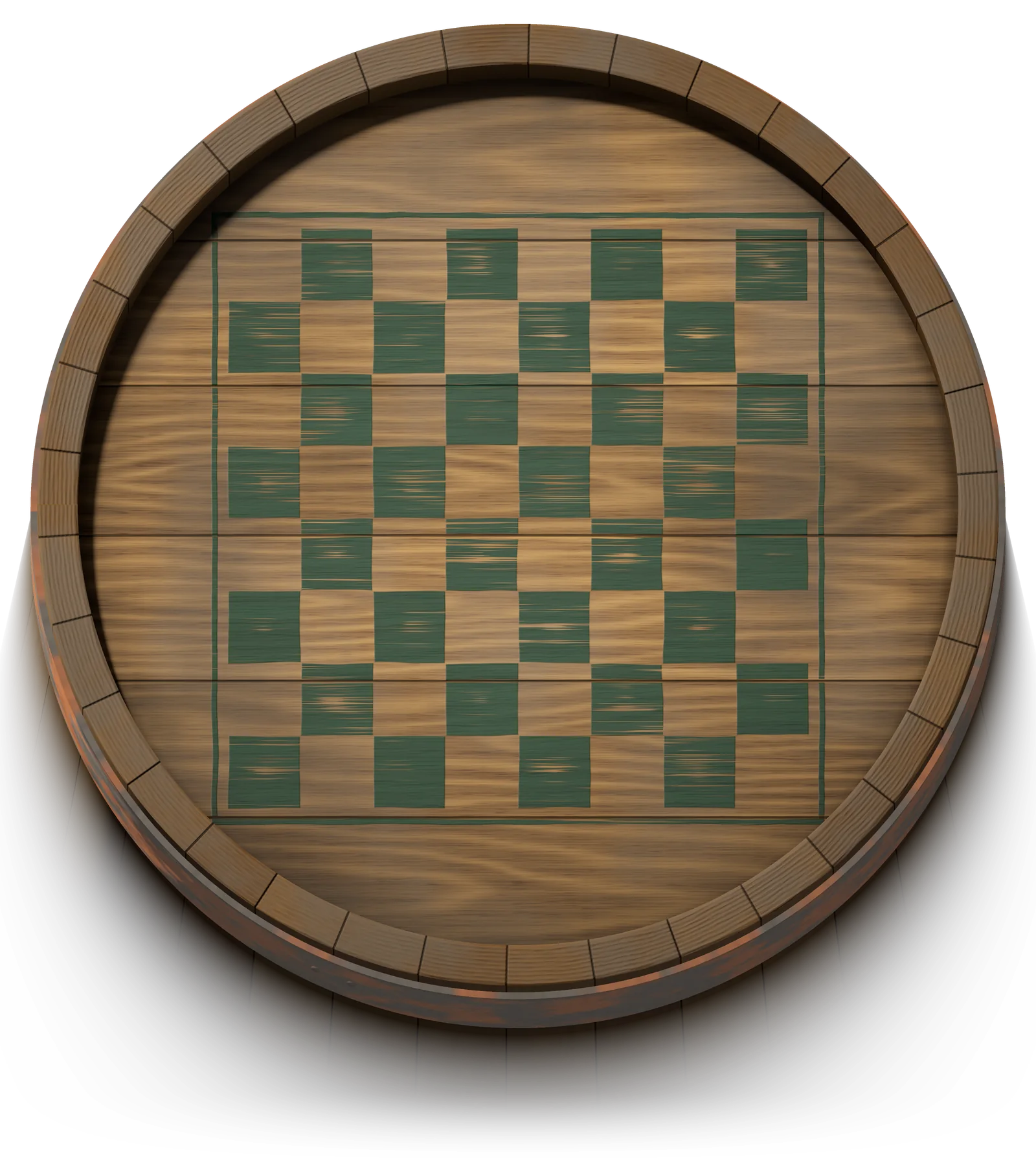
Sixty-four squares, and only the dark ones are used. The board is turned so that each player has a dark square in the corner on the near left.

Twelve pieces each. They start on the dark squares of the three rows nearest their owner, which leaves two empty rows between the sides.

Red goes first. After that the two sides take turns, one move each. Here you play red and move first, unless you choose otherwise under Settings. Your color and the first move are separate choices there, so on this board white can be the side that starts. At a tournament the players draw for colors and swap them from game to game.

Moving

A piece moves one square, diagonally, forward. The square has to be empty. An uncrowned piece never goes backward, and no piece ever lands on a light square.

There is no passing. On your turn you move. If you have no move to make, the game is over, and not in your favor.

Jumping

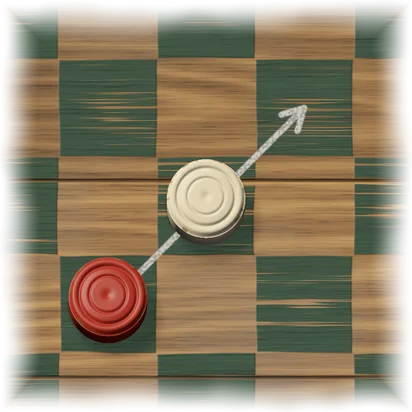
You capture by jumping. If a white piece stands on the next square diagonally ahead of yours and the square right behind it is empty, your piece hops over and the white piece comes off the board.

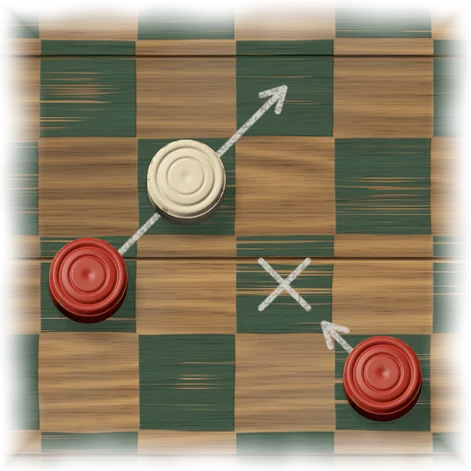
A jump is not optional. If you can jump, you must, even when you would rather not. This board holds you to it: while a jump is open, the pieces that can jump are the only ones that will move.

With more than one jump to pick from, the choice is yours. You do not have to take the one that captures the most.

A red piece next to a white piece, with a chalk arrow showing the red piece jumping over it to the empty square behind.
A jump. Red hops the white piece and takes it.
Two red pieces and one white piece. A chalk arrow shows the red piece on the left jumping the white piece. A shorter arrow from the red piece on the right ends in a chalk cross.
Red must jump. The other red piece may not move.

Double jumps

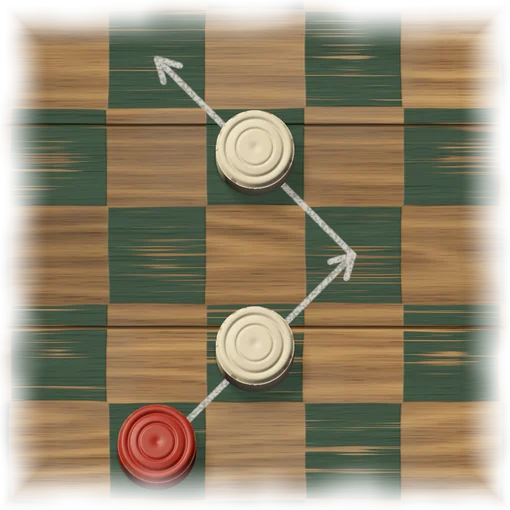
A piece that can jump again keeps going. If another capture is open from the square where it lands, the same piece takes that one too, in the same turn, and so on until there is nothing left for it to take. It may change direction between jumps.

Every jump in the chain still goes forward. An uncrowned piece can zigzag left and right, but it cannot jump backward, not even as the second or third jump.

Once you start, you finish. You may not stop halfway through a chain. If the chain forks, you pick the branch.

A red piece and two white pieces. One chalk arrow shows the red piece jumping the first white piece to the right, and a second arrow shows it jumping the other white piece to the left.
A double jump. Two pieces taken in one turn, both jumps forward.

Kings

Reach the far row and the piece is crowned. The computer sets one of your captured pieces on top of it, so a king is two pieces high. If you have not lost a piece yet, a spare is brought in from the side.

The move ends at the crowning. A piece that jumps into the far row stops there, even if another jump is open from that square. It has to wait for its next turn.

A king still goes one square at a time, but in all four diagonal directions, and it jumps backward as well as forward. It does not slide across the board the way kings do in international draughts.

A king is captured like any other piece. An uncrowned piece can jump it, and both halves come off.

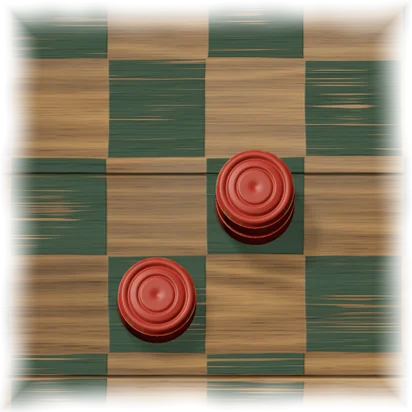
Two red pieces stacked on one square, beside a single red piece.
A king is two pieces, one on top of the other.

How a game ends

You win when the other side cannot move, either because every piece is gone or because the ones left are blocked in.

Being blocked is a loss, not a draw. Checkers has no stalemate.

A draw is called when nobody is getting anywhere. Here that means forty moves each without a capture and without a move by an uncrowned piece, or the same position for the third time. The board calls it on its own. At a tournament a player has to claim the draw and show the referee, and the two players can also simply agree to one.

Sources

Checked against the rules of the World Checkers/Draughts Federation, as published by the American Checker Federation (a Word document), and against the engine that runs this board. Where the two differ, this page says what happens here.

Questions people ask

Do you have to jump in checkers?

Yes. Under the official rules every capture is compulsory: if one of your pieces can jump, you have to make a jump, and if that piece can then jump again, it has to do that too. What you keep is the choice between jumps. If two are open you may take either, and you do not have to pick the one that takes more pieces.

The forced jump is what the tactics of the game are built from. Because your opponent must take what is offered, you can give up one piece to pull an enemy piece onto a square where you take two back.

Many families play that jumping is up to you. That is a house rule. On this board the jump is forced.

Can you jump backward in a double jump?

Not with an ordinary piece. In American checkers an uncrowned piece jumps forward only, and that holds for every jump in a chain. Only a king jumps backward.

The confusion is fair. In international draughts, the game on a hundred squares, and in Russian draughts, ordinary pieces do capture backward. Those are different games.

What happens when a piece becomes a king?

It is crowned and the move ends there. That is true even when the piece arrived by a jump and could jump again from the far row: it stops, gets its second piece, and has to wait until its next turn to use it.

From then on it moves and jumps one square at a time in any diagonal direction. The crowning is not a choice. A piece that reaches the far row becomes a king whether you want one or not.

How does a king jump? Can it take two pieces at once?

One piece at a time, like every other piece. A king jumps over a piece next to it and onto the empty square right behind, and the only difference is that it may go backward as well. It cannot jump two pieces that stand in a row, and it cannot jump a piece from a distance.

It can take several pieces in one turn like any other piece: land, find another one to jump, go again, in any direction. Kings that fly the length of the board belong to international draughts and its relatives.

Can an ordinary piece capture a king?

Yes. A king can be jumped by any piece that is in position to do it, crowned or not. All a king has over an ordinary piece is that it moves and jumps backward as well as forward.

What if a player misses a jump?

The move is taken back and the jump is made. Skipping a capture is an illegal move under the official rules. At a tournament the player is cautioned the first time, and a second illegal move in the same game loses it.

The piece is not forfeited. That was the old penalty, called huffing: the opponent removed the piece that should have jumped. It is no longer in the rules. On this board the question never comes up, because the jump is the only move you are offered.

What happens when a player cannot move?

That player loses. It makes no difference whether the last piece was captured or the pieces that remain are all blocked in. Checkers has no stalemate of the chess kind, where a player with no move gets a draw.

Can a game end in a draw?

Yes, and between strong players it often does. Of forty games between the two strongest levels here, eighteen were drawn.

The official rules give a draw when both players agree to one, when the same position is about to come up for the third time, or when each player has made forty moves without a capture and without an uncrowned piece moving forward. This board applies the last two by itself.

What if there is no captured piece to crown a king with?

You use something else. The official rules say a piece may have to be borrowed from another set, and at a kitchen table a coin does the job. Here the computer crowns your king with one of the pieces it has taken from you. If it has not taken any yet, a spare comes in from the side.

How many kings can you have?

As many as you have pieces, so twelve at most. Every piece that reaches the far row is crowned, and nothing in the rules stops at one or two.

Is checkers the same game as draughts?

American checkers and English draughts are the same game under two names: sixty-four squares, twelve pieces a side, the rules on this page.

Draughts is also the family name for a number of related games. The best known is international draughts, played on a hundred squares with twenty pieces a side. There ordinary pieces capture backward, kings travel any distance, and you must take the jump that captures the most.

What is the best first move?

None of them wins. Red has seven possible first moves, and the engine on this page, looking fourteen moves deep, rates all seven within a twentieth of a piece of each other.

That fits what is known about the game. In 2007 a team at the University of Alberta led by Jonathan Schaeffer published the proof that checkers played without a mistake on either side ends in a draw. The computer on this page is nothing like their program. It looks a few moves ahead, and on the lower levels it gets things wrong on purpose.

How games are won

Leave your back row at home

Nobody can be crowned on a square you are still standing on, so the longer those four stay put, the longer your opponent goes without a king.

When they do have to move, keep two for last: the second and the fourth, counted from the left. Checkers players call that pair the bridge. Every square in front of your back row is next to one of the two, so a white piece that comes up alone is usually jumped before it gets in. The engine here gives the pair extra credit when it weighs a position.

Take the middle

A piece on the edge has half the moves of a piece in the center, and it can only ever help on one side of the board. It cannot be jumped there, which is the whole of its advantage.

Move in pairs

A piece with a friend directly behind it cannot be jumped from the front. Lone pieces out ahead are the ones that get picked off.

Trade when you are ahead

Three against two is a far easier win than nine against eight. Every even exchange makes a one-piece lead count for more. The engine does the same sum: the fewer pieces there are on the board, the more it values being one up.

Read the jump you are offered

Because jumps are forced, a piece left in your way is often bait: take it, and you land exactly where a double jump is waiting.

Then turn it around. Before you move, look for a piece of your own you could give away to drag a white piece onto a square where you take two. A forced jump is the one thing in the game you can count on your opponent to do.

Count a king as a piece and a half

The engine here values a king at a little over one and a half ordinary pieces. By that count, losing one ordinary piece to capture a king is a good exchange, and losing two is a bad one.

Late in the game, chase or hide

With more pieces than your opponent, walk your kings toward the enemy and force the fight. With fewer, head for a double corner: the corner on each player's near right, where the corner square itself is light and two dark squares sit against it. A king can step back and forth between those two for a long time. The engine does both.

Hiding only delays things against two kings. From a position with two kings against one in the double corner, the engine here found the forced win in eleven moves. One king against one is a different matter, so if you are ahead, do not trade down that far.

Use the hint as a second opinion

The Hint button shows the move the engine would make at full strength. Decide on your own move first, then press it. When the two differ, play yours, see what the computer does with it, and press Undo if you want to try the other.

How the computer plays here

Five levels, one engine. What changes is how far it looks and how often it is allowed to be wrong.

How it thinks

The computer tries every move it could make, then every answer you could give, then its answers to those, as many moves deep as the level allows. At the end of each line it scores the position, and it plays the move that leaves it best off if you reply as well as you can.

The score is mostly a count of pieces, with a king worth a little over one and a half. On top of that come small credits for pieces still on the back row, pieces in the center, pieces that are free to move, and uncrowned pieces that have come far up the board.

It never stops counting in the middle of an exchange. A jump has to be answered by whatever jump follows, so every line is followed until the jumping is over.

All of this happens on your own device, in your browser.

Beginner

Looks two moves ahead: its own move and your answer. About three times in ten it does not play its best move at all, but a legal move picked at random. The rest of the time it chooses freely among the moves it rates within a third of a piece of the best. A forced jump is still taken.

Easy

Looks three moves ahead. It plays a random move about one time in eight, and otherwise picks among the moves within a quarter of a piece of its best.

Medium

Looks six moves ahead and no longer plays random moves. It still varies: any move within a tenth of a piece of the best may be the one it plays.

Hard

Looks up to twelve moves ahead, inside a limit of four tenths of a second, and plays the best move it finds or one it rates as good as equal.

Expert

Has no fixed depth. It thinks for up to 1.3 seconds and looks as far as that allows: eleven moves from the starting position on the computer where this was measured, and further as the board empties. After the first few moves of a game it always plays the best move it has found.

In those first few moves every level, Expert included, chooses among openings it rates about equal, so that games do not all begin the same way.

The levels against each other

Each level has played forty games against the level below it, twenty with each color.

  • Easy against Beginner: 33 wins, 5 draws, 2 losses.
  • Medium against Easy: 39 wins, 1 draw, no losses.
  • Hard against Medium: 36 wins, 4 draws, no losses.
  • Expert against Hard: 22 wins, 18 draws, no losses.

Beginner and Easy make mistakes on purpose. The three levels above them never play a move at random. The step from Easy to Medium is the largest of the four, so if Easy has become too easy, expect Medium to be a jolt.

These are games between the levels, measured on 9 October 2026. How each one feels to play against is for you to find out.

What the hint is

The Hint button asks the same engine at full strength: no depth limit, six tenths of a second, never a random move. It is the Expert's opinion with a little less time to think.

Using it does not make the level you are playing any stronger. Every search starts from nothing, and no knowledge carries over from one to the next. Hints are counted, and the count is shown with your record at the bottom of the page.

The other barrels

Backgammon is a race with dice: fifteen pieces a side, and a piece left on its own can be hit and sent back to the start.

Shut the Box is nine numbered tiles and two dice: every roll has to be paid for with tiles that add up to it, and the lower sum left open wins.

Farkle is six dice and a race to 10,000: bank what a turn is worth, or roll again and risk losing all of it.

Yatzy is five dice and a scorecard, thirteen rows the American way or fifteen the Scandinavian: three rolls a turn, and every turn has to be written in a row, even when it is worth nothing there.

Dominoes is twenty-eight tiles and a line that grows at both ends: match a number, draw from the boneyard when nothing fits, and lay your last tile first.

Reversi has one kind of move: put a piece down so that it traps a row of the other color, and the row turns to yours.

Mancala has no dice and nothing hidden: you empty a pit, sow its stones round the board one at a time, and count what ends up in your store.

Chinese Checkers is a race across a star of 121 holes: marbles hop over one another in chains, nothing is ever captured, and the first side to fill the point opposite wins.

Nine Men's Morris is the old game of mills: nine pieces a side, three in a row along a line takes a piece off, and a side left with two pieces or no move has lost.

Tic-Tac-Toe is three in a row on nine squares, and next to it Ultimate tic-tac-toe, where every square holds a small board and each move decides where the next one is played.

Four in a Row is the standing rack laid flat: seven lanes of six places, a piece slides down its lane until it is stopped, and the first side with four in a row wins.

Chess is the old game of kings: six kinds of pieces that each move their own way, and a win when the other king is attacked and cannot escape.

Gomoku is five in a row on a board of fifteen lines each way: pieces go where the lines cross, and three in a row with both ends open has to be answered at once.

Ludo is the race with one die: a six brings a piece out of its yard, landing on another color sends that piece back, and the first side with all four pieces home wins.

No games played yet.

Red for the games you won, white for the ones you lost. Your record is kept in this browser and nowhere else.

Start over?